
Names
Tajik: Чукрӣ (чукурӣ, ревоҷ)
Latin: Rheum maximoviczii Losinsk.
Russian: Ревень Максимовича
Arabic: Рибос, ребос
Ishkashimi: Чыкри
Wakhi: Трышпок
Shughni-Rushani: Шитортък, чукрӣ
Yazgulami: Вадар
English: Rhubarb
Description
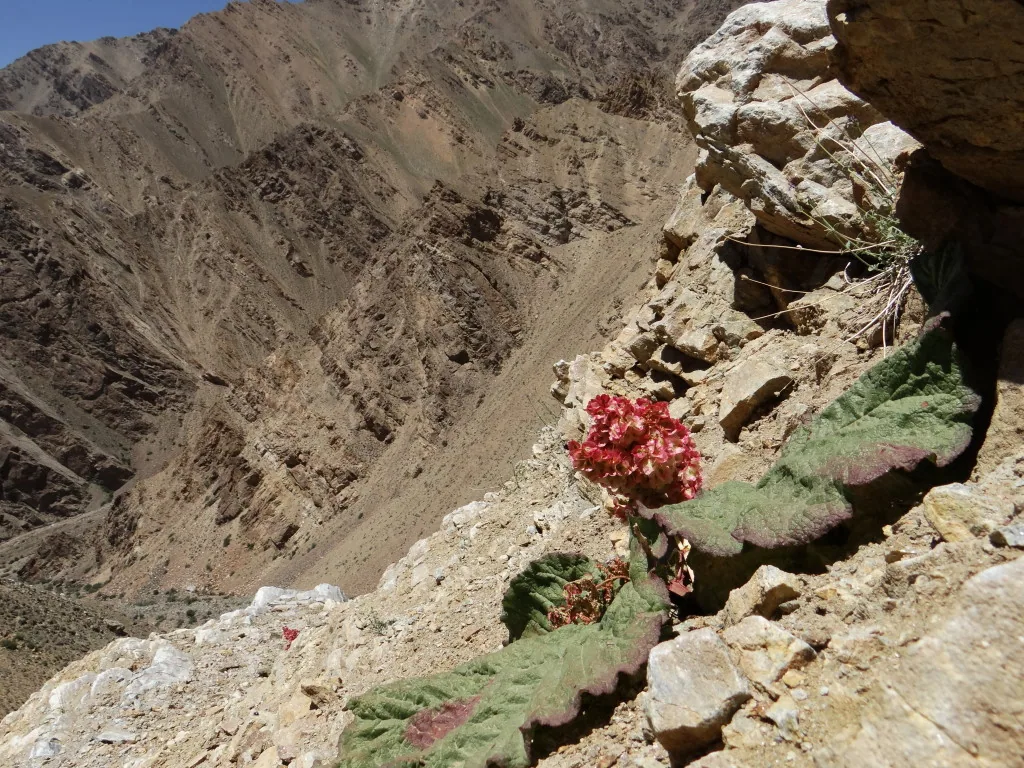
Maximowicz’s rhubarb is a perennial wild-growing plant belonging to the buckwheat family (Polygonaceae).
Its stem is upright and strongly branched, reaches 100–150 cm in height, and has a reddish colour.
The root is thick and many-headed.
The leaves are large, arranged alternately, egg-shaped, and have long stalks.
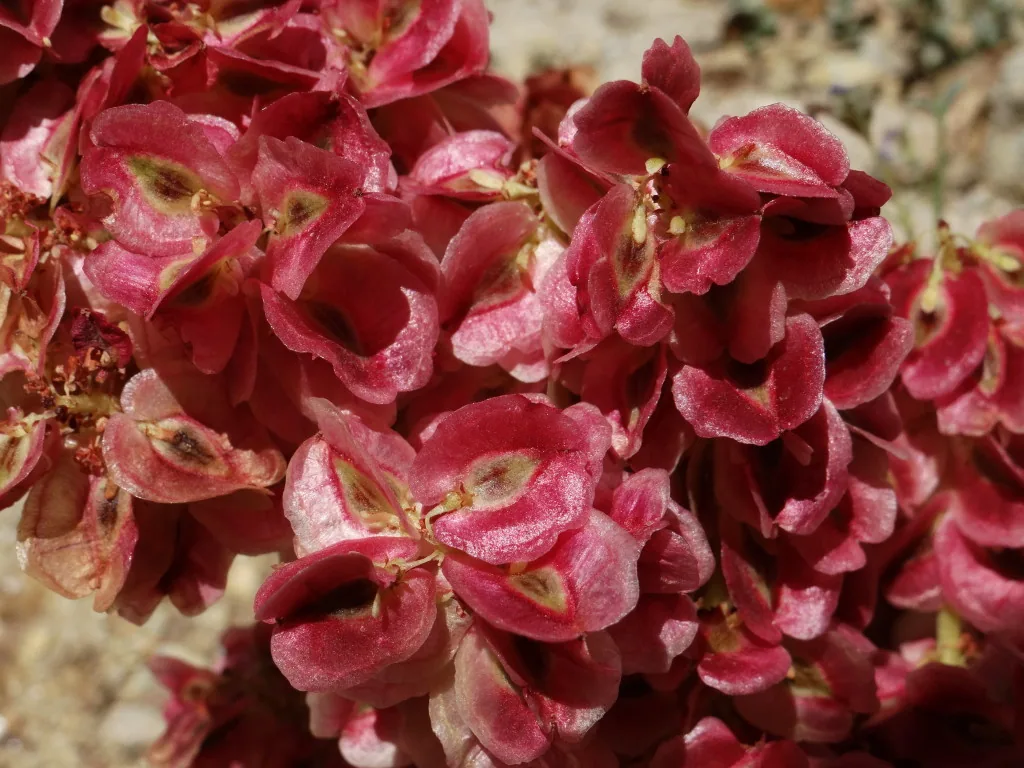
The flowers are small, whitish-pink or red, and are arranged successively in the inflorescence.
The fruit consists of three-winged seeds.
Rhubarb flowers in June when the plant is 2–3 years old.
History and distribution
Central China, southern Mongolia, and Tibet are considered the homeland of rhubarb.
In China, rhubarb was used as medicinal material as early as 2700 BC.
From China, rhubarb reached Persia, then Ancient Greece, and from Ancient Greece it was brought to Western Europe through Arab physicians.
Until the 19th century, rhubarb was exported from China to other countries, while the places where it grew were kept secret.
The seeds of rhubarb were brought to Russia by the Russian traveller N. M. Przhevalsky, after which the plant was cultivated there.
(Safonov N. 2005).
Wild rhubarb is not found in Russia and is cultivated there.
In Badakhshan, rhubarb grows in all districts except Murghab, on hills, in ravines, on slopes, and in valleys at elevations of 1,800–3,900 metres above sea level.
Avicenna considered the nature of rhubarb to be cold and dry in the second degree.
Parts used
The roots and rhizomes of rhubarb are used for medicinal purposes.
The material is collected from plants 2–3 years old in September–October.
The roots are dug out of the ground with a pick and shovel.
They are washed in cold running water, cleaned of soil and foreign material, and cut into pieces 5–10 cm long.
The material is then dried in the sun or in special dryers at a temperature of +40–60°C.
The dried roots are stored in paper boxes or special bags for up to 3 years.
Use in Badakhshan
In Badakhshan, fresh rhubarb is widely consumed in spring and early summer.
In Vanj district, during spring, the stems are placed under stone slabs in the shade and protected from sunlight so that they become more flavourful and juicy.
After some time, the stems become longer, thicker, and more succulent and are then eaten.
Chemical composition
Rhubarb belongs to the group of vitamin-containing plants.
Its stems contain:
- vitamin C — 8–10 mg%;
- vitamin A — 0.6 mg%;
- vitamin B1 — 0.4 mg%;
- vitamin B2 — 0.6 mg%;
- vitamin B6 — 0.08 mg%;
- vitamin B15 — 0.08 mg%;
- vitamin E — 0.02 mg%.
In addition, the roots and rhizomes contain:
- tannins — up to 10%;
- sugars — up to 7%;
- tannin substances — up to 10%;
- anthraglycosides — up to 6%;
- resins;
- starch;
- pectic substances.
The stems contain organic acids and the following macroelements:
- K;
- Ca;
- Mg;
- Fe.
The listed trace elements include:
- manganese;
- Cu;
- Zn;
- Co;
- Al;
- Si;
- Ni;
- Sr;
- Pb.
(Kukes V. G. 1999; Mamadrizokhonov A. 1998; Khaitov I. 2004).
Medicinal properties
In an amount of 0.5–1.0 g, rhubarb has a laxative effect that begins after 8–10 hours.
In smaller amounts, 0.05–0.2 g, it has an astringent effect and promotes constipation.
Rhubarb is also attributed the following properties:
- anti-inflammatory;
- antiseptic;
- choleretic;
- carminative;
- secretion-stimulating;
- general strengthening;
- appetite-stimulating.
Use in medicine
Avicenna used rhubarb for:
- plague;
- high fever;
- reduced vision;
- abscesses;
- blisters;
- sores.
Abumansur Muwaffaq wrote:
“…rhubarb is beneficial for sores of the body, reduces heat, relieves thirst, strengthens the stomach and liver, and prevents vomiting and fainting. Rhubarb mixed with barley flour is applied to abscesses and eczema and is beneficial. Rhubarb is useful for chronic liver disease.”
Use in folk medicine
In folk medicine, rhubarb infusion and decoction are used to stimulate appetite, for chronic inflammation of the large intestine, constipation, and as choleretic preparations.
Use in modern medicine
In modern medicine, rhubarb preparations — powder, infusion, decoction, and tincture — are mainly used for:
- chronic inflammation of the large intestine;
- weakness of the intestinal muscles;
- constipation;
- uterine pain;
- anaemia;
- pulmonary tuberculosis;
- skin eruptions;
- flatulence.
They are also used as choleretic preparations for diseases of the liver and gallbladder.
Medicinal forms, method of use, and dosage
Rhubarb is used both separately and in combination with other medicinal plants.
Rhubarb root infusion
10 g, or one dessert spoon of finely chopped rhubarb root, are placed in an enamelled container and covered with 200 ml, or one glass, of boiling water.
The mixture is infused for 8 hours.
It is then boiled for 30 minutes.
Afterwards, it is strained through 2–3 layers of gauze.
The remaining plant material is pressed.
It is taken daily in an amount of 1/3 of a glass 3 times a day before meals.
Rhubarb stem decoction
20 g, or one tablespoon of finely chopped rhubarb stem, are mixed with 200 ml, or one glass, of boiling water.
The mixture is boiled over low heat or in a water bath for 20 minutes.
It is then cooled and strained through 2–3 layers of gauze.
The remaining plant material is pressed.
The volume of the decoction is restored to the original amount.
It is taken daily in an amount of 1/3 of a glass 3 times a day, 30 minutes before meals.
The decoction is used for:
- bleeding;
- uterine pain;
- constipation of the stomach and intestines;
- hiccups;
- bloody diarrhoea;
- kidney diseases;
- bladder diseases.
Rhubarb root powder
Rhubarb root powder is taken in an amount of 0.5–1.0 g before sleep.
Its laxative effect begins after 8–10 hours.
In a small amount, around 0.05 g, it has the opposite, constipating effect.
After taking rhubarb preparations, urine, milk, and sweat may become yellow in colour.
Contraindications
Rhubarb preparations — infusion, decoction, and powder — should not be used by people with:
- gout;
- kidney stones formed from oxalate salts;
- haemorrhoids.
Warning
Information about medicinal properties, methods of use, and dosages on this page comes from the source text and partly belongs to folk and traditional medicine.
The text gives different amounts of rhubarb that may have a laxative or, conversely, astringent effect depending on the dose.
The information is provided for educational and informational purposes and should not be used as a guide to self-treatment.