
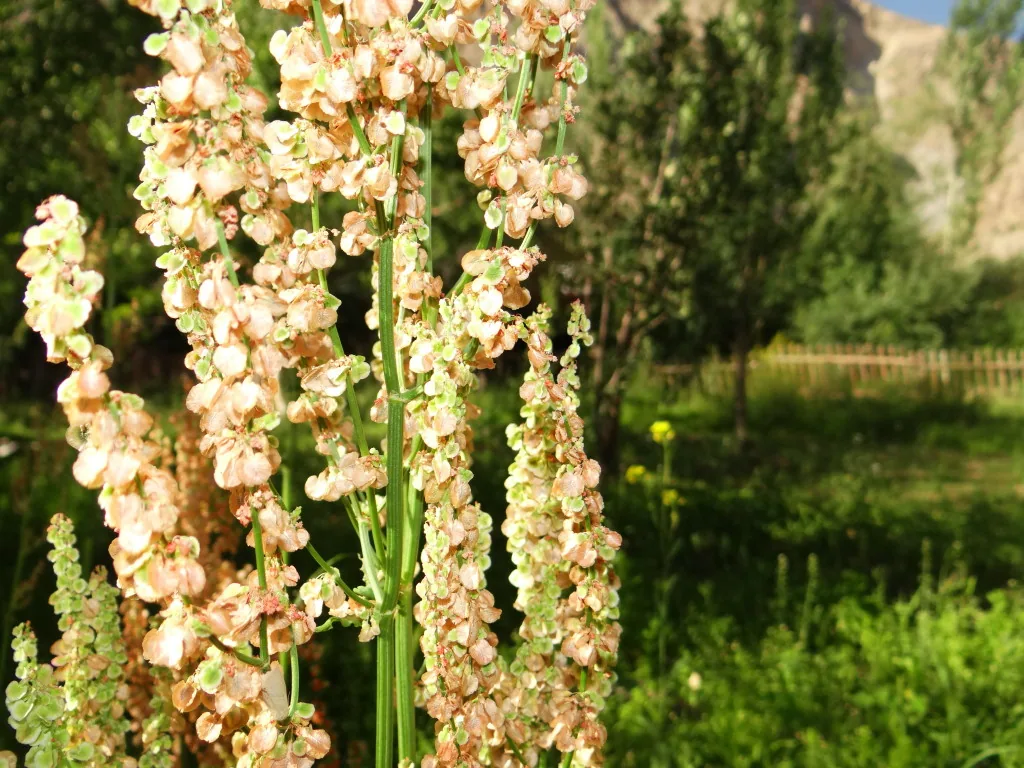
Names
Tajik: Марвак (мармарак, гавазнгиёҳ, марямгул, марямгули мастурак, мак-мак, марямӣ, кампиргулак)
Latin: Salvia officinalis L.
Russian: Шалфей лекарственный
Arabic: Раъӣ-ул-айил
Ishkashimi: Турушак
English: Garden sage
Description
Garden sage is a perennial herbaceous plant belonging to the mint family (Labiatae).
The name of the genus is derived from the Latin word “Salivis”, meaning “healthy” or “well”.
The Mediterranean coast is considered the homeland of sage.
In Tajikistan, sage was cultivated in the Isfara and Istaravshan districts.
In Badakhshan, in the Ishkashim district, sage grows on summer pastures and in mountainous areas at elevations of 2,500–3,000 metres above sea level.
Its stem is upright, strongly branched, hairy, reddish-violet, and reaches 30–70 cm in height.
The leaves are oval, stalked, and 5–15 cm long.
The flowers are bisexual and may be white or pink.
The fruit is rounded and brown, while the root penetrates the soil to a depth of 1.5–2 metres.
Sage flowers in June–July, and its seeds ripen in September–October.
The plant has a pleasant and aromatic smell.
(Khojimatov M. 1989).
Avicenna considered the nature of sage to be gently hot and drying in the second degree.
Muhammad Zakariya considered the nature of sage seeds to be hot in the second degree and moist in the first degree.
Parts used
For medicinal purposes, the leaves, flowers, and upper part of the stem are used.
During summer, the leaves are collected 2–3 times.
At the beginning and end of flowering, the middle and lower leaves are collected, while in autumn all the leaves together with the tips of the branches are gathered by hand.
The material is dried in the shade, in a well-ventilated place, or in dryers at a temperature of +35–40°C.
The dried material is stored in paper or cardboard boxes for up to 2 years.
Chemical composition
Sage contains:
- flavonoids;
- alkaloids;
- tannins;
- resinous substances;
- organic acids;
- vitamins P and PP;
- phytoncides;
- olein;
- nicotinic acid;
- essential oils.
The essential oils are described as containing:
- thujone;
- pinene;
- salvene;
- borneol;
- cedrene;
- cineole;
- and other substances.
(Azonzod J. 2010; Kurennov I. 2008; Khaitov I. 2004).
Medicinal properties
Sage is attributed the following properties:
- anti-inflammatory;
- anticonvulsant;
- reducing perspiration;
- astringent;
- haemostatic;
- softening;
- antidotal;
- carminative;
- expectorant;
- calming;
- reducing breast milk production in nursing mothers;
- diuretic;
- choleretic.
Use in medicine
Ancient medical authorities Hippocrates, Galen, and Dioscorides regarded sage as a “sacred herb” and considered it one of the most useful medicinal plants.
Avicenna used sage as an antidotal remedy for snake and scorpion bites.
Use in folk medicine
In folk medicine, sage infusion and decoction are used for diseases of the respiratory system.
These include:
- inflammation of the respiratory passages.
They are also used for digestive disorders:
- acute inflammation of the stomach;
- chronic inflammation of the stomach;
- inflammation of the small intestine;
- inflammation of the large intestine.
Sage is also used for:
- inflammation of the liver;
- inflammation of the gallbladder;
- gallstone disease;
- palpitations;
- nervous disorders of the heart;
- nervousness.
Sage decoction and infusion are also used for inflammatory conditions of the mouth and throat.
These include:
- sore throat;
- inflammation of the gums;
- toothache;
- inflammation of the oral mucosa;
- fungal diseases of the mouth in children.
Sage is also used for:
- forgetfulness;
- parkinsonism;
- sores at the corners of the lips.
(Kovaleva N. G. 1971; Nuraliev Y. 1989).
Use for infertility and in Bulgarian medicine
Sage juice is used in cases of infertility.
In Bulgaria, sage leaf infusion is used for night sweating associated with pulmonary tuberculosis and in women during menopause.
It is also used for:
- reducing breast milk production in nursing mothers;
- inflammation of the stomach;
- gastric ulcer;
- duodenal ulcer with reduced secretion of gastric juice;
- inflammation of the liver;
- inflammation of the gallbladder.
Use in European medicine
In Germany, Poland, and France, sage is used as a remedy with the following attributed properties:
- anti-inflammatory;
- disinfecting;
- softening;
- astringent;
- reducing perspiration;
- strengthening the central nervous system.
Austrian researchers identified a factor referred to as PP in sage leaves.
The text states that, together with the other properties of sage, this substance has an oestrogen-like, or follicular-hormone, effect.
Sage leaves are also used for:
- stomach diseases;
- intestinal diseases;
- inflammatory diseases of the mouth, in the form of gargles;
- high arterial blood pressure;
- atherosclerosis;
- parkinsonism;
- therapeutic baths;
- douching.
Sage leaf was included in the pharmacopoeias of many countries, including the pharmacopoeia of the former Soviet Union in 1961.
(Kovaleva N. G. 1971).
Medicinal forms, method of use, and dosage
Sage is used in the form of infusions, decoctions, alcoholic tinctures, and powder.
Sage leaf infusion
10 g, or two teaspoons of leaves, are placed in an enamelled container and covered with 200 ml, or one glass, of boiling water.
The mixture is heated in a water bath or over low heat.
It is then cooled at room temperature for 45 minutes and strained through 2–3 layers of gauze.
The remaining plant material is pressed.
It is taken daily in an amount of 1/3 of a glass 3 times a day, 30 minutes before meals.
The infusion is also used for:
- gargling;
- washing wounds and sores;
- compresses and dressings;
- inhalation.
Infusion of the above-ground parts of sage
10 g, or two teaspoons of stems, leaves, and flowers, are placed in an enamelled container and covered with 200 ml, or one glass, of boiling water.
The mixture is infused for 20 minutes.
It is then strained through 2–3 layers of gauze.
The remaining plant material is pressed.
It is taken daily in an amount of 1/3 of a glass 3 times a day, one hour after meals.
The infusion is recommended for menopausal syndrome.
Sage herb infusion
20 g, or one tablespoon of the material, are infused in 200 ml, or one glass, of boiling water for 20 minutes and then strained.
Three parts of the infusion are mixed with one part apple cider vinegar.
The mixture is used for compresses and for washing wounds and sores.
Bath with sage and carrot juice
Sage infusion is mixed with carrot juice in a ratio of 30:500.
The mixture is added to bath water at a temperature of +37°C.
The bath is taken for 15–20 minutes.
A course consists of 12–14 baths.
The baths are recommended for:
- eczema;
- inflammation of the spinal nerve roots (radiculitis).
Pharmaceutical preparations
Sage leaves are produced in paper packages of 50 g.
Salvin is produced as a 10% solution in 10 ml containers and is used for topical application, washing, applications, and tampon use.
An alcoholic tincture of sage is prepared in a ratio of 1:10 with 70% alcohol.
It is taken in amounts of 15–25 drops 3 times a day before meals.
Contraindications
Sage preparations are contraindicated in:
- acute nephritis;
- pregnancy;
- inflammation of the kidneys;
- severe cough.
Warning
Information about medicinal properties, methods of use, and dosages on this page comes from the source text and partly belongs to folk and traditional medicine.
The text mentions the use of sage for infertility, menopausal syndrome, kidney diseases, and other serious conditions. This information should not be used as a guide to self-treatment.
The material is provided for educational and informational purposes.