
Names
Tajik: Қоқу
Latin: Taraxacum
Russian: Одуванчик
English: Dandelion
Description
Taraxacum is a large genus of flowering plants in the Asteraceae family.
Members of the genus are native to Eurasia and North and South America.
The source material specifically mentions two species — Taraxacum officinale and Taraxacum erythrospermum — which are found as weeds in many parts of the world.
The source also states that both species are edible in their entirety.
The common English name dandelion comes from the French expression dent-de-lion, meaning “lion’s tooth”.
Like other members of the Asteraceae family, dandelions have many very small flowers collected together into a composite flower head.
Each individual flower within the head is called a floret.
Many species of Taraxacum are able to produce seeds asexually through apomixis.
In this process, seeds are formed without pollination, producing offspring that are genetically very similar to the parent plant.
Plant structure
Species of Taraxacum are tap-rooted biennial or perennial herbaceous plants.
They are native to temperate regions of both the Old World and the New World.
The leaves are approximately 5–25 cm long or longer.
They are simple and basal, entire or lobed, and form a rosette above the central taproot.
The flower heads are yellow to orange.
They open during the daytime and close at night.
Each flower head is usually borne singly on a hollow stem known as a scape.
The stem may rise approximately 1–10 cm or more above the leaves.
When broken, it releases a milky latex.
A single rosette may produce several flowering stems at the same time.
The flower heads are approximately 2–5 cm in diameter.
They consist entirely of ray florets.
Seed head
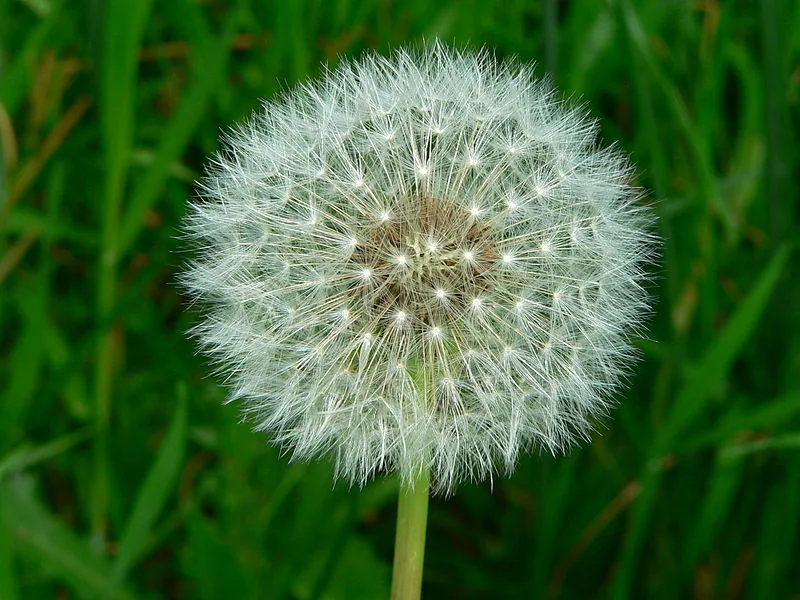
After flowering, the flower head gradually develops into a spherical seed head.
It contains many single-seeded fruits known as achenes.
Each achene is attached to a structure made up of fine hairs.
These hairs allow the seeds to be carried by the wind over considerable distances.
After flowering is complete, the flower head dries for one or two days.
The dried petals and stamens fall away, the surrounding bracts bend backwards, and the seed head opens into an almost complete sphere.
Bracts of the flower head
The flower head is surrounded by bracts arranged in two series.
The inner bracts remain upright until the seeds mature.
After maturation, they bend downward and allow the seeds to disperse.
The outer bracts are generally reflexed downward.
In some species, the hair-like structure may separate from the achene.
This hair-like structure is called the pappus and is botanically regarded as a modified calyx.
Between the pappus and the achene is a slender stalk known as the beak.
It elongates as the fruit matures.
The beak separates from the achene relatively easily, disconnecting the seed from its parachute-like structure.
Seed dispersal
Many species of Taraxacum are plants that rapidly colonize disturbed or open ground.
This is especially characteristic of the common dandelion, Taraxacum officinale.
This species has become widespread throughout much of the temperate world.
Dandelion seeds are dispersed by wind.
Their fine hairy structure acts like a small parachute and allows the seeds to travel away from the parent plant.
Similar plants
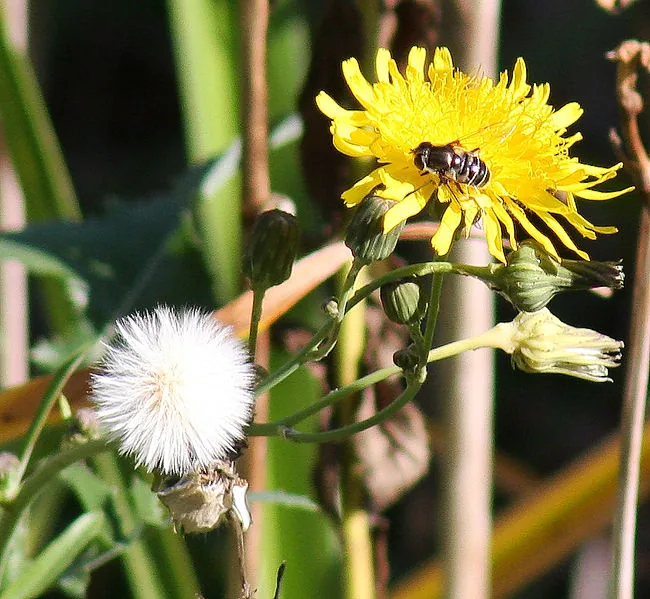
Several other yellow-flowered plants in the Asteraceae family may resemble dandelions.
The source material specifically mentions catsear (Hypochaeris), hawkweed (Hieracium), and hawksbeard (Crepis).
Dandelions and catsear (Hypochaeris) can look similar from a distance.
Both produce yellow flower heads and wind-dispersed seeds.
However, there are several botanical differences between them.
In dandelions, each flower head is borne on a separate flowering stem that is generally:
- unbranched;
- hairless;
- leafless;
- hollow.
In catsear (Hypochaeris), the flowering stems are branched, solid, and bear bracts.
Both plants have a basal rosette of leaves and a central taproot.
However, dandelion leaves are generally smooth or nearly hairless, while catsear leaves are usually more coarsely hairy.
Hawkweed (Hieracium) and hawksbeard (Crepis) also have flowers that can resemble those of dandelions.
They can usually be distinguished by their branched flowering stems, which are often hairy and bear leaves.
Note
This page is based on the provided source material and focuses primarily on the botanical characteristics of the genus Taraxacum, the structure of the plant, seed dispersal, and differences between dandelions and several similar plants.
The source material does not provide specific information about medicinal uses or therapeutic properties of dandelions.