
Names
Tajik: Сулӣ (бомус)
Latin: Avena sativa L.
Russian: Овес посевной
Arabic: Ҳартумон
Ishkashimi: Десел, дисин
Wakhi: Ғрымвщык, лос
Shughni-Rushani: Дъесак
Yazgulami: Кушк, кышнак
English: Cultivated oat
Description
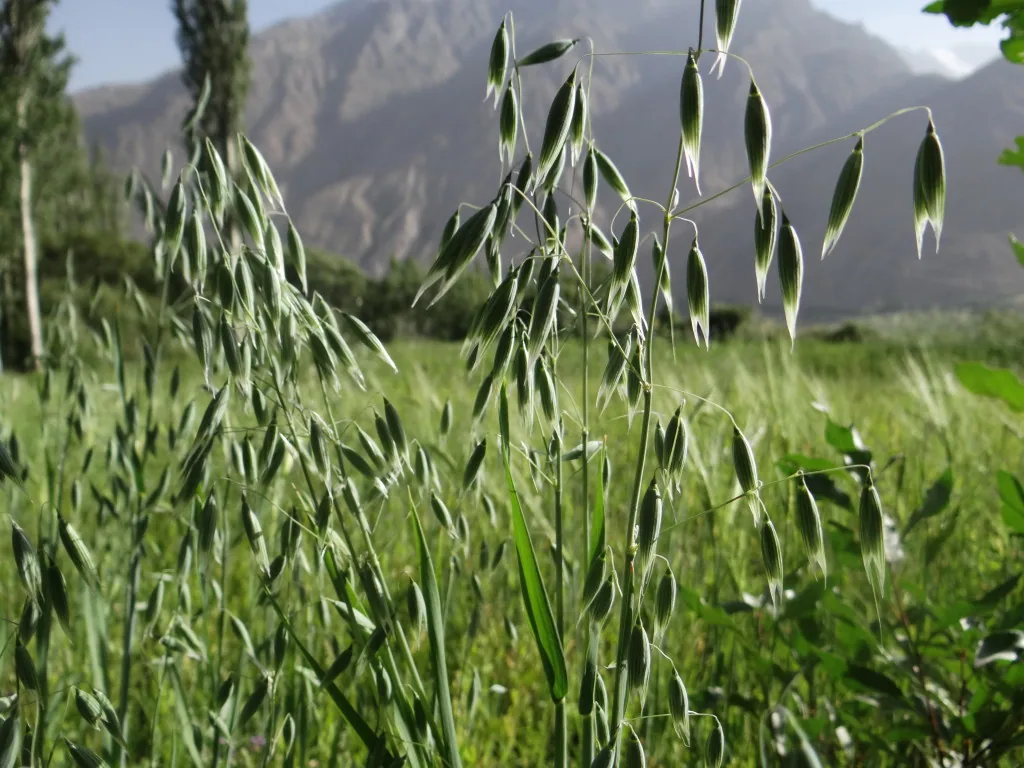
Cultivated oat is an annual cereal plant belonging to the grass family (Graminaceae).
Its stem is upright, with strong nodes, and reaches up to 130 cm in height.
The leaves are long, arranged alternately, and pointed at the tip.
The panicle is white or brownish and pointed.
The flowers are bisexual.
Under the conditions of Badakhshan, oat flowers in June–July.
Oat is a moisture-loving and cold-resistant plant.
It is sown as a cereal crop in early spring.
The grain ripening period lasts 211 days, and the seeds ripen in September–October.
Four species of oat grow in the western districts of Badakhshan, one of which is cultivated oat and may occur as a weed in crop fields.
Avicenna considered the nature of oat to be moderate and inclined toward moisture.
Parts used
For medicinal purposes, the grain, stems, and leaves of oat are used.
Oat is also used as coarse fodder for livestock.
It is harvested in September–October.
The leaves and stems are collected during the flowering period.
Chemical composition
Oat grain contains:
- starch;
- proteins;
- glucose;
- fructose;
- maltose;
- raffinose;
- sucrose;
- essential and non-essential amino acids;
- choline;
- vitamins B1, B2, and B6;
- fats;
- flavonoids.
The listed macroelements include:
- K;
- Ca;
- Na;
- Mg;
- Si;
- P;
- Ci.
The listed trace elements include:
- Al;
- B;
- Fe;
- I;
- V;
- Co;
- Mn;
- Cu;
- Mo;
- Ni;
- Sn;
- Ti;
- Sr;
- F;
- Cr;
- Zn.
(Nuraliev Y. 1989; Kurennov I. 2008).
Medicinal properties
Oat is attributed the following properties:
- softening;
- calming;
- strengthening of the nervous system;
- strengthening of the body;
- mild laxative;
- antioxidant.
Use in medicine
Avicenna wrote:
“…the strength of oat is between barley and wheat, and its flour is more astringent and more dissolving than barley flour.”
Muhammad Husayn Shirazi, author of “Makhzan-ul-Adwiya”, wrote:
“…the nature of oat is moderately cold and inclined toward dryness.”
Oat was considered able to dissolve substances and retain them in the stomach.
Oat cooked with oil was used for expectorant and anti-cough purposes.
Cooked oat with oil was also considered to have astringent properties.
Oat was considered heavy for the stomach and capable of causing gas.
To reduce this undesirable effect, the use of plenty of oil, vinegar, lemon, and quince was recommended.
If oat food remained heavy in the stomach, eating something sweet was recommended.
Use in folk medicine
In folk medicine, soup made from oat groats is used for:
- urinary retention in children;
- rickets;
- shirincha.
A decoction of oat groats with honey is used as a strengthening preparation for:
- pulmonary tuberculosis;
- weakened patients;
- recovery after severe illness;
- diabetes.
An infusion of oat straw is used for weakness of the nervous system, to stimulate appetite, and for insomnia.
Use in modern medicine
In modern medicine, a mucilaginous oat decoction is used for:
- inflammation of the liver;
- inflammation of the stomach with reduced acidity;
- inflammation of the small and large intestines;
- gastric ulcer;
- duodenal ulcer;
- weakness of the nervous system;
- weakness of the intestines.
Oat bran and oat groats are used to lower blood cholesterol.
Oat and preparations made from it are also used for certain skin conditions.
These include:
- eczema;
- chronic inflammation of the skin;
- diathesis in children.
Baths made from oat straw are used for:
- skin diseases;
- diseases of the thyroid gland;
- prolonged colds;
- rheumatism;
- gout;
- inflammation of the sciatic nerve;
- persistently cold hands and feet.
(Sokolov S. Y. 2008).
Medicinal forms, method of use, and dosage
Oat straw infusion
One tablespoon of finely chopped oat straw is infused in one glass of boiling water for 30 minutes and then strained.
It is taken in an amount of half a glass 3 times a day before meals.
The infusion is used for inflammatory joint conditions and gout.
Oat grain infusion
500 g of oat grain are infused in 1 litre of boiling water for 40 minutes.
After straining, it is taken in an amount of half a glass 3 times a day before meals.
The infusion is used for inflammatory conditions of the gallbladder.
Oat grain decoction as a diuretic and choleretic
One glass of oat grain is placed in 1 litre of boiling water and simmered over low heat until the liquid volume is reduced by about one quarter.
After straining, it is taken in an amount of half a glass 3 times a day before meals.
Oat straw decoction for joint pain
0.5–1 kg of oat straw is placed in 3 litres of water and boiled for 30 minutes.
It is then cooled and strained.
The decoction is used for baths at a temperature of +35–36°C for 5–10 minutes.
Alcoholic oat tincture as a strengthening preparation
Oat straw is finely chopped and used to fill a 0.5-litre bottle.
Alcoholic liquid is poured over it and left to infuse for 2–3 weeks.
The straw is then pressed and the tincture is strained.
It is taken in an amount of 20–30 drops with one tablespoon of water.
(Kurennov I. 2008).
Warning
Information about medicinal properties, methods of use, and dosages on this page comes from the source text and partly belongs to folk and traditional medicine.
The information is provided for educational and informational purposes and should not be used as a guide to self-treatment.