
Names
Tajik: Пуши умумӣ
Latin: Artemisia vulgaris
Russian: Полынь обыкновенная, чернобыльник, чернобыль
English: Common wormwood, mugwort
Description
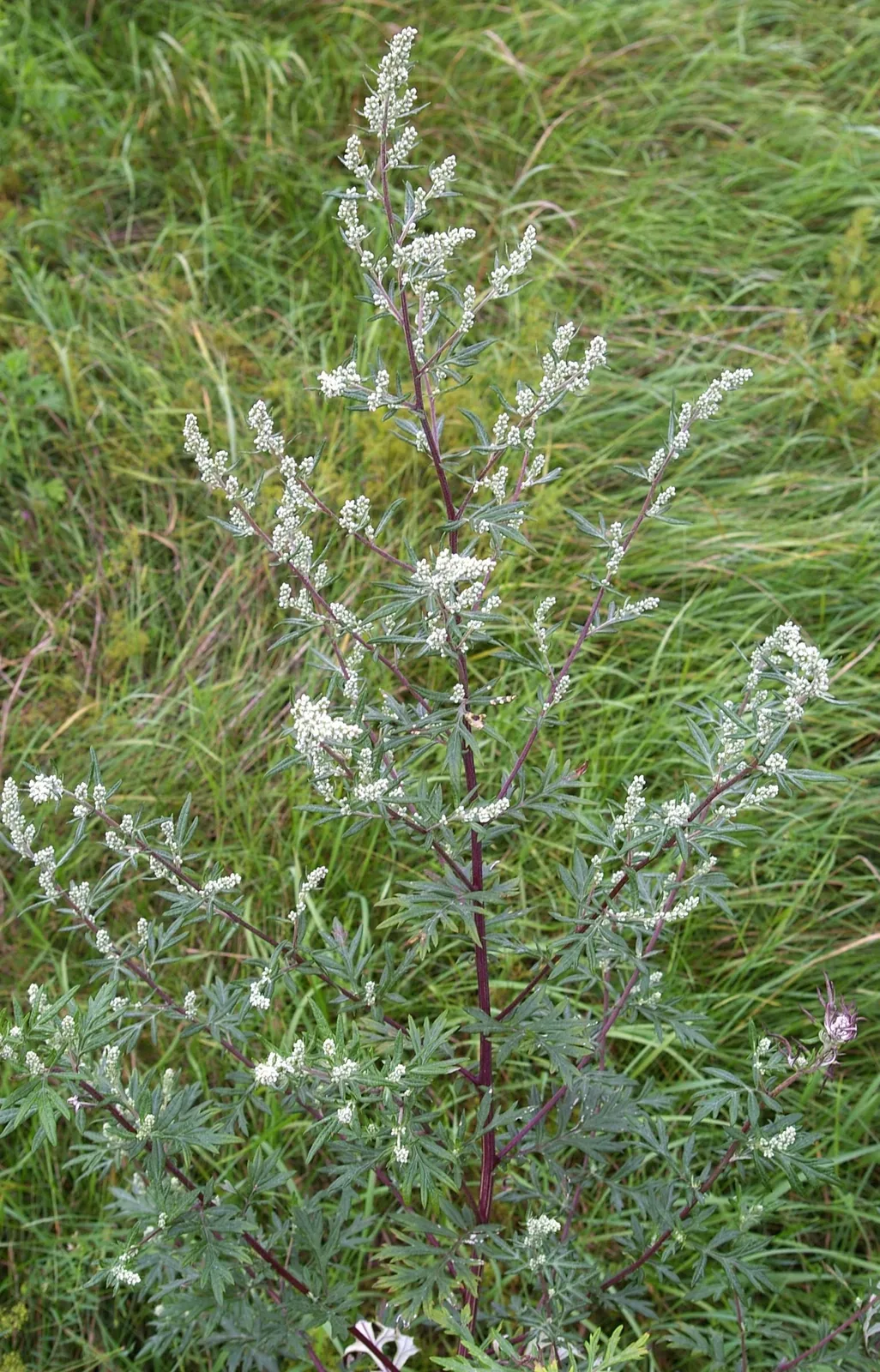
Common wormwood is a perennial branched plant of the genus Artemisia.
The source material notes that Artemisia vulgaris is one of several species commonly known as mugwort and is the species most often referred to by that name.
The plant usually reaches approximately 0.5–2 metres in height, and more rarely up to 2.5 metres.
The stem is leafy along its entire length, upright, brownish with a violet tint, and angular-ribbed in cross-section.
The rhizome is multi-headed or shortly creeping and thickened in its upper part.
The leaves are soft and twice or three times pinnately divided.
Their segments are broadly lanceolate or linear-lanceolate.
The leaves are approximately 5–20 cm long.
The upper surface is light or dark green, hairless or only slightly hairy.
The lower surface is densely covered with hairs and appears whitish or silvery.
The source specifically notes this contrast between the upper and lower surfaces of the leaves as one of the features distinguishing common wormwood from the closely related wormwood, Artemisia absinthium.
The upper leaves are smaller and simpler.
The terminal leaf segments are approximately 2.5–9 mm wide.
Several pairs of small ear-like lobes are visible at the base of the leaf stalk.
The flowers are small, numerous, and yellow or brownish.
The flower heads are upright and arranged in loose panicle-like inflorescences.
The stalks of the flower heads are approximately 0.5–1 mm long.
Common wormwood flowers from July to September.
The fruits ripen from July to October.
Distribution and habitat
The English section of the source states that Artemisia vulgaris is native to temperate Europe, Asia, northern Africa, and Alaska.
The plant has also become naturalized in North America.
In some regions it is regarded as an invasive weed.
Common wormwood frequently grows on nitrogen-rich soils.
It is commonly found in waste places, uncultivated land, along roadsides, and in other disturbed areas.
Flowers and insects
The source material describes the flowers as radially symmetrical and yellow or dark red in colour.
The numerous narrow flower heads are arranged in panicle-like clusters.
It also states that the leaves and flowers are eaten by a number of species of Lepidoptera, including butterflies and moths.
Chemical composition
The source material mentions the following substances in common wormwood:
- carotene;
- ascorbic acid;
- saponins;
- tannins;
- alkaloids;
- essential oil.
In France, Morocco, Germany, Hungary, India, China, and Japan, essential oil is obtained from dried flowers and leaves by steam distillation.
The oil is described as a pale yellow or colourless liquid with a strong bitter-sweet aroma and a camphor-like note.
The source lists the following components of the essential oil:
- thujone;
- cineole;
- borneol;
- pinenes.
It also states that the oil blends well with oakmoss, patchouli, rosemary, lavender, pine, sage, and cedar oils.
Culinary use
The above-ground parts of common wormwood are used as a spicy seasoning for various foods.
The source particularly mentions its use with rich or fatty foods, including goose, duck, pork, and pork fat.
In some areas the plant is cultivated specifically for culinary purposes.
In Korean cuisine, common wormwood is added to tteok.
Small quantities of the leaves are also used by hunters as a seasoning when preparing game in field conditions.
Properties mentioned in medicine
The source material attributes a number of properties to common wormwood.
It states that the plant may:
- improve appetite;
- support digestion;
- have a tonic effect;
- have a calming effect;
- support blood formation;
- support wound healing;
- have a choleretic effect;
- act as a mild laxative.
These statements are presented as part of the source material and should not be interpreted as modern medical recommendations.
Use in medicine
The source material states that common wormwood has been used to improve appetite and digestion.
It is also mentioned in connection with stomach function and fever.
A decoction of the leaves is described in the source as having been used in enemas to stimulate the liver and as an anthelmintic preparation.
The source also mentions the use of common wormwood in connection with:
- exhaustion;
- insomnia;
- various neuroses;
- colds;
- malaria;
- influenza;
- epilepsy.
In addition, a mixture of common wormwood with thyme is mentioned in the source in connection with the treatment of alcohol dependence.
This information is included as source-derived material and is not a direct medical recommendation.
Use in traditional medicine
The above-ground parts and roots have been used in the traditional medicine of various countries.
The source associates their use with the following conditions:
- gastritis;
- tuberculosis;
- oedema;
- haemorrhoids;
- hypertension;
- painful menstruation;
- absence of menstruation;
- flatulence;
- epilepsy;
- neurasthenia;
- meningitis;
- leprosy.
This list reflects traditional and historical uses and should not be interpreted as evidence of modern medical effectiveness.
Essential oil
The source material attributes the following properties to the essential oil of common wormwood:
- antispasmodic;
- wound-healing;
- diuretic;
- stimulating;
- stomach-supporting;
- tonic.
These statements are retained as part of the source material.
Important note
This page is based on the provided source material and combines botanical, culinary, traditional, and medical information about common wormwood.
Some of the medicinal uses mentioned belong to traditional medicine and historical sources and should not be interpreted as modern medical advice or instructions for self-treatment.
When considering the use of any plant for medicinal purposes, consultation with a qualified medical professional is necessary.