
Names
Tajik: Косни (коснич, каснач, кошнич, кошнича, кабра, шири харак, талҳа, талҳаи кабуд, чатроқоқу, чарашқу, чачараксу)
Latin: Cichorium intybus L.
Russian: Цикорий дикий (горьчанка, татарский цвет, щербак, цикорий корневой)
Arabic: Ҳандбо, ҳиндобо
Ishkashimi: Косни
Shughni-Rushani: Кизнач
Yazgulami: Коснич
English: Blue-sailors
Description
Chicory is a perennial wild-growing plant belonging to the daisy family (Compositae).
The plant reaches up to 150 cm in height.
The stem is upright and strongly branched.
The leaves are long, pinnate or lance-shaped, and arranged alternately.
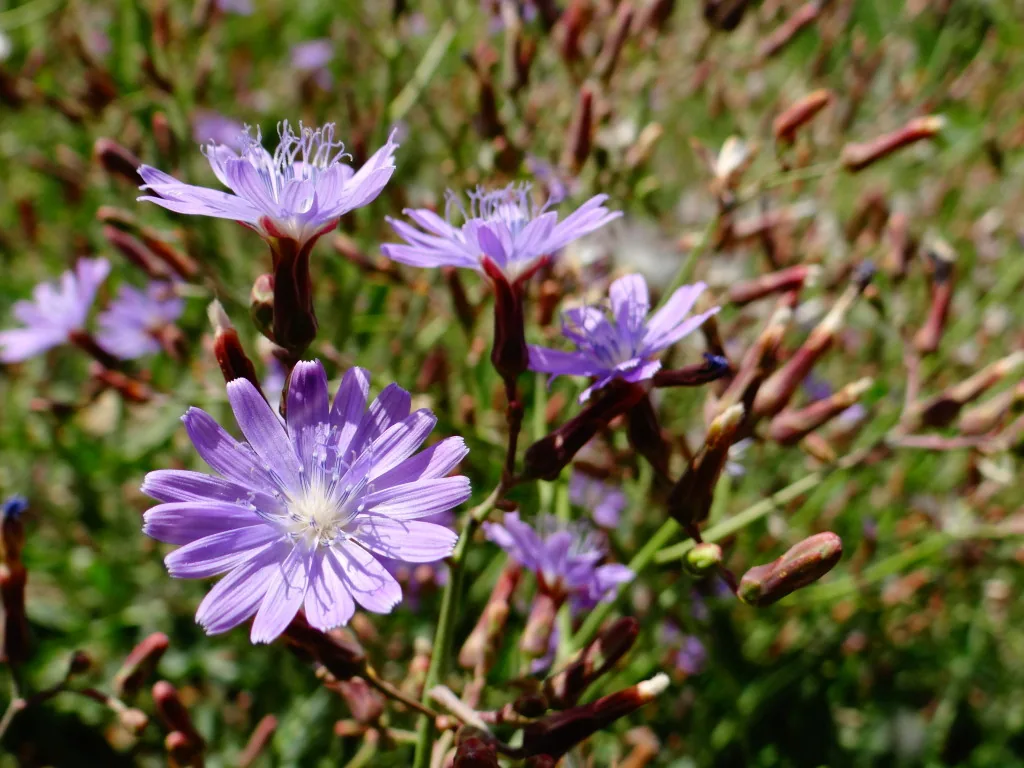
The flowers are blue or violet-blue and bisexual.
Chicory flowers in June–July, and its seeds ripen in August–September.
It usually grows along irrigation channels, roads, rivers, in fields, gardens, and vegetable plots at elevations of 1,800–3,000 metres above sea level.
The leaves, stems, and flowers are collected during flowering.
The roots are harvested in autumn, in October–November.
The leaves, stems, and flowers are dried in a shaded, well-ventilated place.
The roots are dried in the sun, in the open air, or in special dryers at a temperature of +40–60°C.
The leaves, stems, and flowers are stored in paper or wooden boxes for 1–2 years, while the roots and rootlets may be stored for up to 5 years.
The nature of dried chicory is considered dry in the first degree, while fresh chicory is considered cold and moist at the end of the first degree.
Parts used
The stems, leaves, flowers, roots, and rootlets of chicory are used for medicinal purposes.
Chemical composition
Chicory roots contain:
- inulin — 11–65%;
- proteins — 3.6%;
- fatty oil — 0.3%;
- nitrogen-free compounds — 15.4%;
- fructose — 2.3–9.5%;
- bitter glycoside;
- resinous substances.
The roots and leaves contain choline and vitamin K.
The flowers contain:
- chicorin glycoside;
- vitamin C — up to 150 mg%;
- coumarin.
The leaves contain such macroelements as:
- calcium;
- copper;
- sodium;
- potassium;
- iron.
The listed trace elements include:
- phosphorus;
- manganese.
The leaves also contain lactucin, lactucopicrin, vitamin C, B-group vitamins, carotene, tannins, and essential oils.
The above-ground part of the plant contains:
- vitamin C — 70–350 mg%;
- carotene — 1.23%;
- tannins — 1.3–2.3%;
- flavonoids — 0.2–0.4%;
- coumarins — 0.17–0.7%;
- vitamin B1 — 0.05%;
- vitamin B2 — 0.03%;
- vitamin PP — 0.24%.
(Khojimatov M. 1989; Nuraliev Y. 1989).
Medicinal properties
Chicory is attributed the following properties:
- anti-inflammatory;
- antimicrobial;
- diuretic;
- choleretic;
- calming;
- hypotensive;
- antidiabetic;
- astringent;
- wound-healing.
Use in medicine
Avicenna used chicory for diseases of the eyes, gout, conditions affecting the chest, heart, stomach, and liver, and for four-day fever.
He also used chicory ointment as an antidote on the sites of snake, scorpion, bedbug, and bee bites.
Use in folk medicine
Folk healers use chicory roots and blooming flowers for conditions such as:
- kidney stones;
- gallstones;
- metabolic disorders;
- rheumatism;
- gout;
- inflammation of the joints;
- ulcers of the stomach and intestines;
- inflammation of the stomach and intestines;
- diseases of the pancreas;
- poor appetite.
(Safonov N. N. 2005).
In folk medicine, the ash of the above-ground part of chicory is also mixed with cream and applied as a dressing for skin conditions.
These include:
- nomla;
- sores;
- wounds;
- burns.
Chicory juice is used for bloody diarrhoea and pain in the digestive organs.
An infusion of chicory together with chamomile flowers is also used for diseases of the kidneys, spleen, liver, and stomach.
Chicory seeds are used as a fever-reducing and diaphoretic remedy.
(Khojimatov M. 1989).
Use in Russian and Austrian folk medicine
In Russian and Austrian folk medicine, a decoction of chicory root is used as a diuretic, appetite stimulant, and digestive tonic.
It is also used for:
- liver diseases;
- spleen diseases;
- intestinal diseases;
- weakness;
- fainting;
- elevated blood sugar;
- normalisation of blood composition.
(Kovaleva N. G. 1971).
Medicinal forms, method of use, and dosage
Infusions, decoctions, juice, and powdered preparations are made from the roots, stems, leaves, and flowers of chicory.
Chicory root decoction
20 g, or one tablespoon of dried chicory root, are placed in an enamelled container, covered with 0.5 l of boiling water, and heated in a water bath for 30 minutes.
After cooling, the decoction is strained through 2–3 layers of gauze.
The remaining plant material is pressed.
The volume of the decoction is restored to its original amount.
It is taken daily in an amount of 1/4 of a glass, half an hour before meals.
The decoction is used for diseases of the liver, gallbladder, kidneys, jaundice, and other conditions.
Infusion of chicory stems, leaves, and flowers
40 g, or two tablespoons of medicinal plant material, are infused in 0.5 l of boiling water for one hour.
The infusion is then strained through 2–3 layers of gauze.
It is taken daily in an amount of 0.5 glass 3 times before meals.
This infusion is used for jaundice, liver diseases, inflammation of the stomach and intestines, and kidney diseases.
Warning
Information about medicinal properties, methods of use, and dosages on this page comes from the source text and partly belongs to traditional and folk medicine.
The information is provided for educational and informational purposes and should not be used as a guide to self-treatment.