
Names
Tajik: Зира, зиракаҳ, зираи форсӣ, лунда зира
Latin: Carum carvi
Russian: Тмин обыкновенный
Arabic: Комун
Ishkashimi: Зира
Wakhi: Зира
Shughni-Rushani: Зира
Yazgulami: Зира
English: Caraway
Botanical note
The Tajik list of names also includes Bunium persicum (Boiss) and Bunicum cyminum L.
However, the Russian and English botanical descriptions, as well as the photographs used for this article, refer to common caraway — Carum carvi. Therefore, this page is devoted specifically to Carum carvi.
Description
Caraway is a plant of the Apiaceae family, also known as the Umbelliferae.
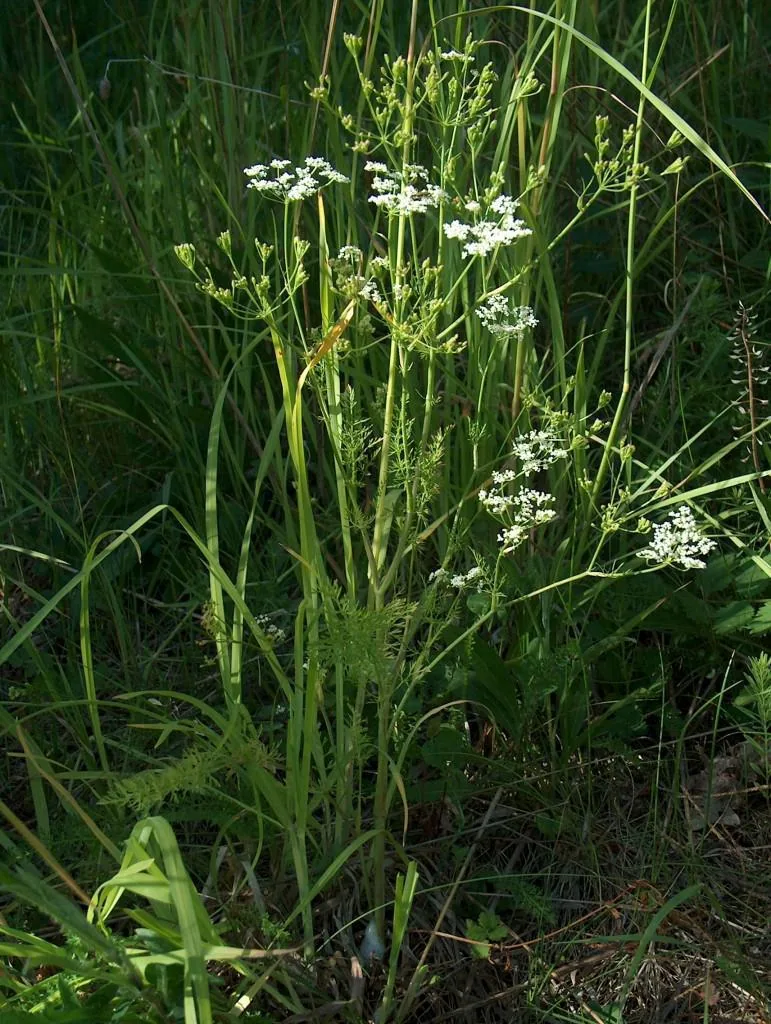
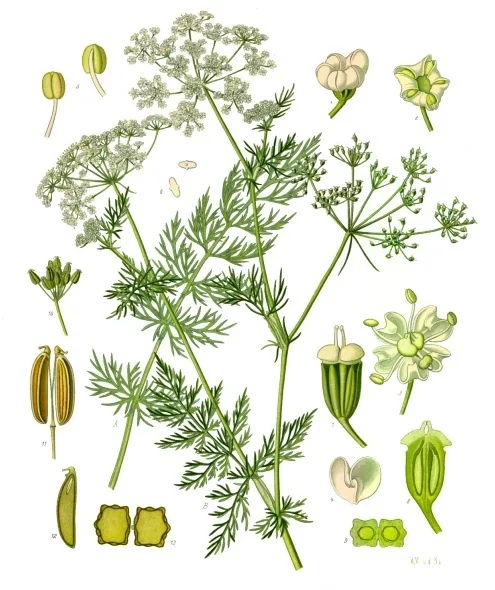
The stem is upright, smooth, hollow, and strongly branched in its upper part.
The plant usually reaches about 30–80 cm in height and may sometimes grow up to 1 m.
The root is spindle-shaped or cylindrical and fleshy.
The leaves are elongated and divided two or three times into fine segments.
The basal leaves grow on long stalks, while the upper leaves have shorter stalks.
Umbel-shaped inflorescences are located at the ends of the branches and at the top of the stem.
The flowers are small and white or pinkish.
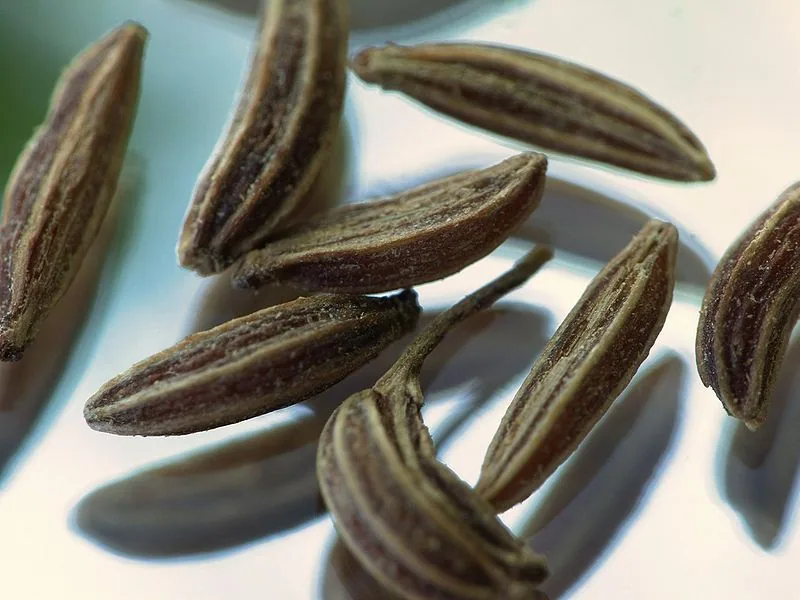
The fruits are flattened, elongated, brown, and marked with distinct longitudinal ridges. In everyday language they are often called caraway seeds.
Caraway has a characteristic spicy aroma and a sharp, aromatic flavour.
In Badakhshan, zira is found in various districts except Murghab, growing on slopes, hills, foothills, ravines, and in valleys.
Its growing range is described as approximately 600–3,800 m above sea level.
Avicenna considered the nature of zira to be hot in the second degree and dry in the third degree.
Abumansur Muwaffaq described it as hot and dry in the second degree.
In ancient medical tradition, Kirmani zira was considered superior to Persian zira, while Persian zira was regarded as better than some other varieties.
Parts used
The fruits of caraway, commonly called seeds, are the main part used.
They are used both as a spice and in traditional medicine.
The leaves and young shoots may also be used as food.
Chemical composition
Caraway fruits contain:
- essential oil;
- fatty oil;
- proteins;
- tannins;
- flavonoids;
- coumarins;
- mineral substances.
The fruits may contain approximately 3–7% essential oil and 12–22% fatty oil.
The flavonoids listed include:
- quercetin;
- kaempferol.
Other compounds include:
- umbelliferone;
- scopoletin;
- other coumarin compounds.
Carvone is considered the main component of the essential oil, accounting for about 50–60%.
Other components include:
- D-limonene;
- carvacrol;
- linalool;
- cymene;
- pinene;
- other aromatic compounds.
Unripe fruits may contain a higher proportion of limonene than mature fruits.
The green parts of the plant also contain quercetin, kaempferol, and isorhamnetin.
The roots contain ascorbic acid and carbohydrates.
Medicinal properties
Caraway has traditionally been attributed the following properties:
- tonic;
- diuretic;
- carminative;
- appetite-stimulating;
- haemostatic;
- diaphoretic;
- antispasmodic;
- choleretic;
- digestive-supporting.
It has also been associated with reducing spasms of the intestinal smooth muscles and supporting the activity of digestive glands.
Culinary use
Caraway is widely used as a spice.
The fruits have a strong aroma with an anise-like character.
They are used to flavour baked goods, especially some types of rye and dark bread.
Caraway is also added to:
- soups;
- sauces;
- meat dishes;
- pilaf;
- cheeses;
- sauerkraut;
- confectionery;
- various European and Middle Eastern dishes.
In home cooking, the fruits are also used when pickling cucumbers, fermenting cabbage, and preparing kvass.
Caraway pairs particularly well with meat, including lamb.
The leaves and young shoots may be used in salads or as flavouring for soups and other dishes.
The roots are also cooked as root vegetables in some culinary traditions.
Use in traditional medicine
Caraway has long been used primarily in connection with digestive complaints.
The fruits were included in various medicinal teas and herbal mixtures, including preparations described as:
- appetite-stimulating;
- laxative;
- carminative;
- calming;
- stomach-supporting.
Infusions of the fruits were used for intestinal disorders, gallbladder problems, bronchitis, pneumonia, digestive spasms, and headache.
Use in traditional medicine of Badakhshan
In the traditional medicine of Badakhshan, zira infusions were used for various digestive disorders.
These included:
- inflammation of the stomach with reduced secretion;
- inflammation of the liver;
- inflammation of the gallbladder;
- intestinal colic;
- flatulence;
- poor appetite.
Zira was also used in connection with some kidney and urinary tract disorders.
These included:
- inflammation of the renal pelvis and calyces;
- some kidney disorders;
- difficulty urinating.
It was also used for certain types of swelling that were associated with disorders of the heart, liver, or kidneys.
Alongside its medicinal uses, zira has long been valued for flavouring bread, cheese, pilaf, and other dishes.
Use in ancient medicine
Avicenna used zira fruits in connection with gout, intestinal and stomach colic, and as a remedy against intestinal parasites.
Abumansur Muwaffaq described zira as carminative, haemostatic, and diuretic.
He also mentioned its use in connection with disorders of:
- the stomach and intestines;
- the liver;
- the kidneys;
- the eyes;
- certain types of bleeding.
These descriptions belong to ancient medical tradition and are not modern treatment recommendations.
Information from H. Zohidov
H. Zohidov (1991) described a number of traditional ways of using zira.
It was combined with vinegar, olive oil, and other substances for both internal and external use.
These traditional methods were associated with:
- nosebleeds;
- shortness of breath;
- palpitations;
- certain eye conditions;
- toothache;
- stomach and intestinal disorders;
- liver and kidney disorders;
- some types of swelling;
- wounds and injuries.
Traditional sources also describe putting zira preparations into the nose or eyes and using it in cases of snakebite.
Such methods are historical and should not be used without medical supervision. In particular, homemade plant preparations should not be put into the eyes.
External use
Zira was also used externally in traditional medicine.
Forms of use included:
- ointments;
- compresses;
- enemas;
- drops.
Ground zira was mixed with oil or flour and applied to certain swellings, wounds, and injuries.
These methods belong to traditional medical practice.
Essential oil
Caraway essential oil is used to flavour some medicinal preparations.
It is also used in the production of:
- soap;
- perfumes;
- lotions;
- aromatic products.
Carvone and limonene contribute significantly to the characteristic aroma of caraway.
Caraway and bees
Caraway flowers provide pollen and nectar for honey bees.
Bees visit the flowers during the flowering period.
Cultivation
Caraway prefers warm and sunny locations.
Well-drained soil rich in organic matter is suitable for its growth.
Depending on the climate, it may be cultivated as an annual or biennial plant.
Forms of use
Traditional preparations made from caraway include:
- infusions;
- decoctions;
- herbal mixtures;
- ointments.
The fruits are also added directly to different foods as a spice.
Some traditional sources mention an amount of up to 7 g per day. This is historical dosage information and should not be regarded as a universal safe amount for self-treatment.
Warning
A significant part of the medicinal uses described on this page belongs to folk medicine and historical medical sources.
Methods involving eye conditions, bleeding, diseases of the heart, kidneys, liver or urinary tract, snakebite, and other serious conditions should not be used as substitutes for medical diagnosis and treatment.
In traditional medicine, zira was considered unsuitable in some stomach conditions, including increased gastric acidity, gastric ulcers, and duodenal ulcers.
The information on this page is provided for educational, historical, and informational purposes.
When considering caraway for medicinal use, especially in the presence of chronic illness, during pregnancy or breastfeeding, or while taking medication, consultation with a qualified medical professional is necessary.