Names
Tajik: Афсантин (тхарч, тихач, тахач, дарманаи румӣ, дирамнаи румӣ, шиҳи румӣ, талхшуоқ)
Latin: Artemisia absinthium L.
Russian: Полынь горькая (абсент, вермут, горечь, горькая трава, полынь настоящая, пелун)
Arabic: Афсинтин
Ishkashimi: Талхакаҳ
Wakhi: Тылхака
Shughni-Rushani: Цихъсдахц
Yazgulami: Чушвехъ
English: Wormwood, absinthe
Description
Wormwood is a perennial herbaceous plant belonging to the Compositae family.
In the original material, wormwood is classified as a poisonous plant.
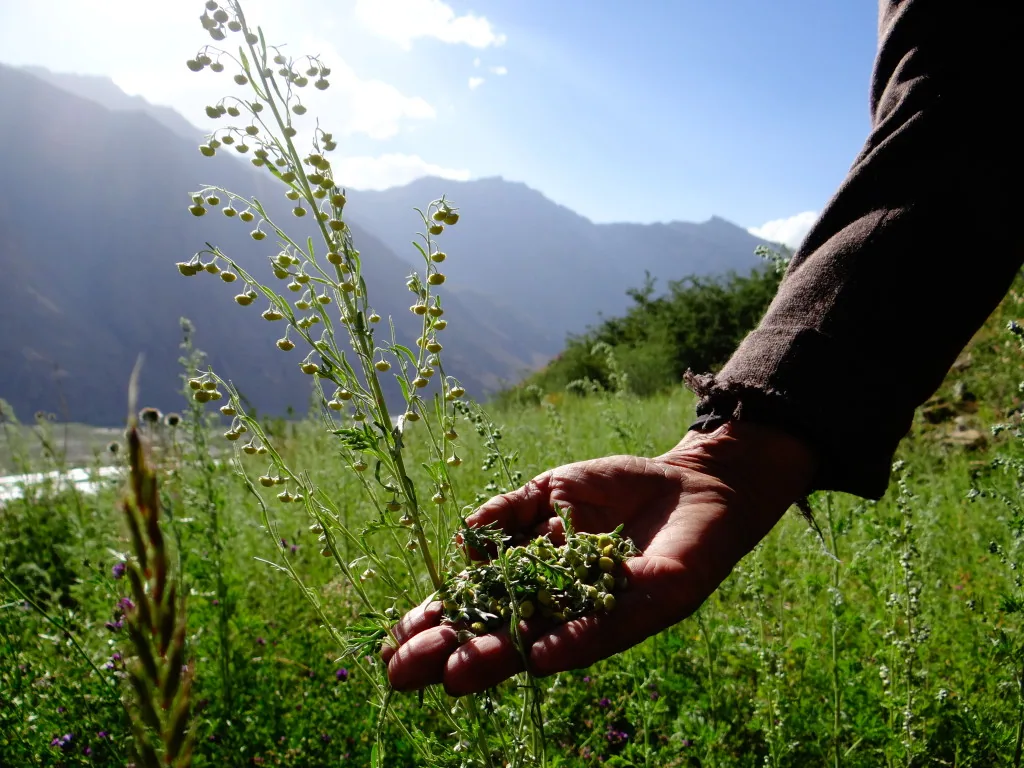
It may reach approximately 1–1.5 metres in height.
The plant has a distinctive smell and an extremely bitter taste. For this reason, in the Ishkashim district it is known as “Талхакаҳ”.
Wormwood grows in all districts of Badakhshan, occurring in vegetable plots, meadows, along irrigation channels, and on cultivated land.
It is found at elevations of approximately 1,800–3,000 metres above sea level.
The plant flowers in July–August, while its seeds ripen in September.
The original material states that Avicenna regarded wormwood as hot in the first degree and dry in the third degree, and noted that its expressed juice was considered even hotter.
The source also cites H. Zohidov, who described wormwood as hot and dry in the second degree.
Parts used
For medicinal purposes, the entire above-ground part of the plant — leaves, flowers, and stems — is used.
The leaves are collected in late June and July.
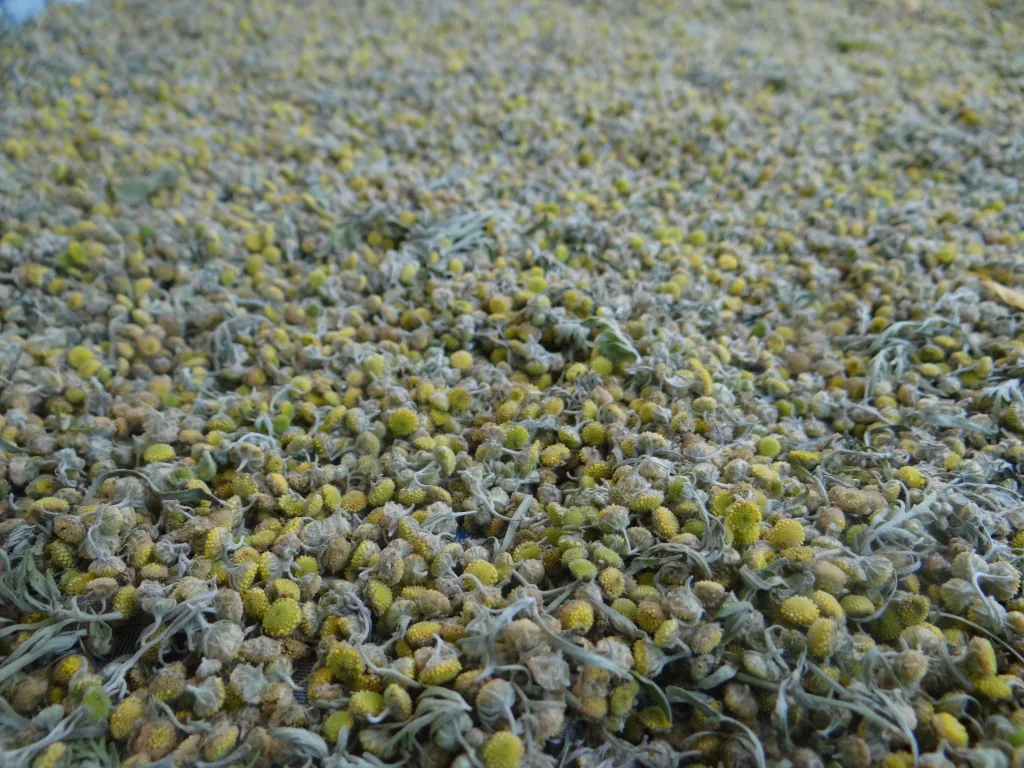
The stems and flowers are collected from July to September and dried under shelters, in attics, or in other well-ventilated places.
The dried material is stored in boxes or bags.
The original material gives a storage and use period of up to two years.
Chemical composition
The original material mentions the following components in wormwood:
- vitamin C;
- vitamin B6;
- vitamin K;
- glycosides, including absinthin and anabsinthin;
- the flavonoid artemisetin;
- organic acids, including malic and succinic acids;
- carotene;
- essential oils;
- other biologically active substances.
Medicinal properties
The original material attributes the following properties to wormwood:
- diuretic;
- choleretic;
- anthelmintic;
- antimicrobial;
- anti-inflammatory;
- astringent;
- carminative;
- expectorant;
- appetite-stimulating;
- insect-repelling.
Use in medicine
The original material mentions wormwood in connection with some disorders of the digestive system.
These include inflammation of the stomach with increased acidity, impaired digestion, intestinal colic, flatulence, and chronic inflammatory conditions of the liver, gallbladder, and pancreas.
Wormwood is also mentioned as an appetite stimulant, as a remedy for unpleasant breath, and as an anthelmintic.
Infusions and alcoholic tinctures are described in connection with anaemia, haemorrhoids, menstrual disorders, certain kidney conditions, epilepsy, rheumatism of the joints, insomnia, injuries of the musculoskeletal system, and as a calming remedy for the nervous system.
The source also mentions oil obtained from wormwood seeds in connection with certain conditions of the oral mucosa, wounds, ulcers, boils, and swellings.
Leaves and flowers were also used together with other medicinal plants.
Use in traditional medicine
In the traditional medicine of Tajikistan, an infusion prepared from wormwood flower heads was used in connection with haemorrhoids and as a choleretic, diuretic, diaphoretic, antipyretic, and anthelmintic remedy.
The original material also states that Avicenna used wormwood infusions, alcoholic preparations, and juice in connection with a number of conditions.
These included hard swellings of internal organs, certain diseases of the ears and eyes, dropsy, disorders of urination, haemorrhoids, and anal fissures.
The source also mentions its use as an appetite stimulant, against intestinal worms, and in cases of snake and scorpion bites.
Traditional information attributed to H. Zohidov
According to H. Zohidov (1991), the original material describes a number of traditional ways of using wormwood.
These include a decoction of wormwood combined with plaster clover and olive oil and applied as a compress.
The source also mentions use with vinegar for painful joints, with beeswax in the form of suppositories, and in combination with certain foods and other plants.
Wormwood mixed with honey is also mentioned in connection with certain conditions of the eyes, ears, oral mucosa, throat, liver, gallbladder, and other organs.
These descriptions represent traditional and historical uses and should not be interpreted as modern medical recommendations.
Household use
The original material states that dried wormwood was placed in suitcases, chests, and wardrobes to help protect clothing from moths and other insects.
Wormwood water or decoction was also used in places where fleas were present.
Medicinal forms
The original material mentions the use of wormwood in the following forms:
- extract;
- water infusion;
- alcoholic tincture.
The infusion was also used alone or in combination with other substances for external applications.
The source additionally mentions use in the form of enemas and poultices.
Extract and alcoholic tincture
The original material states that wormwood extract and alcoholic tincture were taken in amounts of 15–20 drops three times a day, approximately 30 minutes before meals.
Wormwood infusion
10 g, or approximately two teaspoons of the herb, are placed in an enamelled container and covered with 200 ml of boiling water.
The container is tightly covered and heated in a water bath for approximately 15 minutes.
The infusion is then cooled at room temperature for about 45 minutes.
After cooling, it is strained through 2–3 layers of gauze.
The remaining plant material is pressed, and the total volume of the infusion is restored to 200 ml.
The original material states that the infusion should be stored in a cool place for no longer than two days.
It also mentions taking approximately one quarter of a glass three times a day, 30 minutes before meals.
The source states that wormwood was also produced for medical use in 200 g packages.
Warning
The original material explicitly describes wormwood as a poisonous plant.
It also states that prolonged use may lead to poisoning, adversely affect the nervous system, and cause hallucinations and convulsions.
For this reason, the source emphasizes that treatment with wormwood should be carried out under medical supervision.
The original material also states that wormwood should not be used during pregnancy because of the mentioned risk of miscarriage.
Its use is also contraindicated in the source for people with gastric ulcers.
The information on this page is presented solely for educational, historical, and informational purposes and should not be used as instructions for self-treatment.