Names
Tajik: Газна (газак, газанга, газанда, газандиёр, газангир, анҷара, анҷура, оҳтирак, сӯзанбарг, сӯзгиёҳ, тавланг, сӯзанкаҳ, сӯзанда)
Latin: Urtica dioica L.
Russian: Крапива двудомная (стреканка, жигалка, стрекучка, жгучка, жалива)
Arabic: Қурраис, анҷура, алқарис
Ishkashimi: Газак, пучпучоник
Wakhi: Пычпычонук
Shughni-Rushani: Чидгинц, цағинц
Yazgulami: Сӯзанкаҳ
English: Stinging nettle, great nettle
Description
Stinging nettle is a perennial stinging plant belonging to the nettle family (Urticaceae).
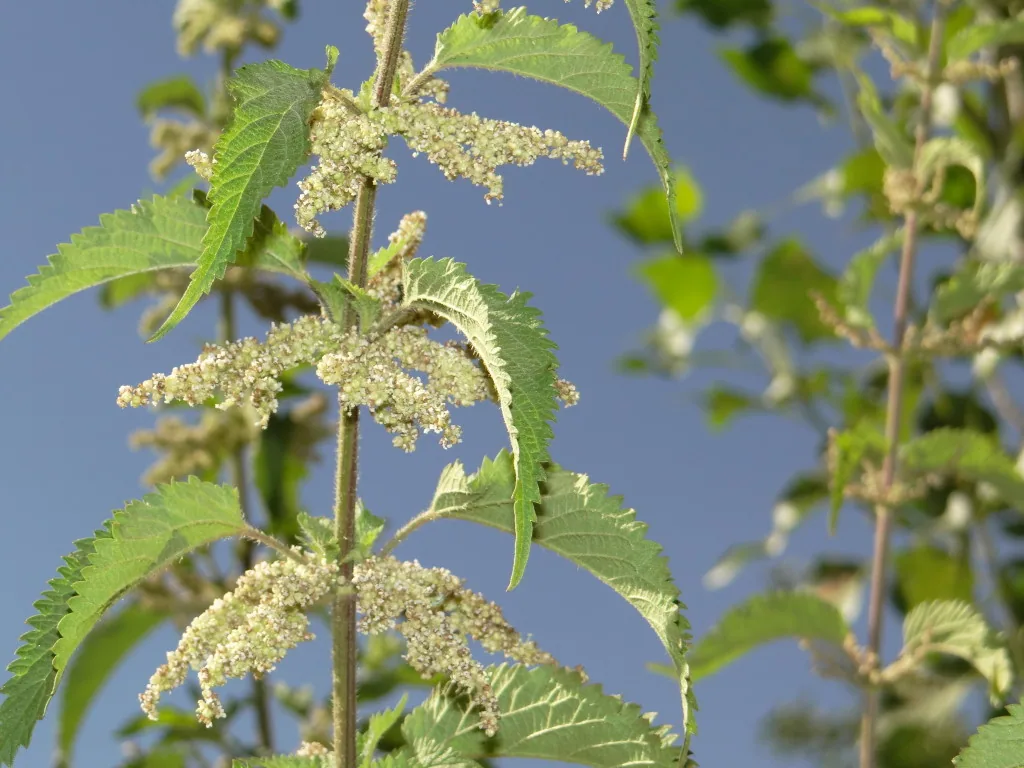
Its stem is upright and branched and reaches 30–150 cm in height.
The leaves resemble mulberry leaves and are dull green in colour.
The stem and leaves are covered with stinging hairs. Their composition includes formic acid, silicic acid, and histamine.
When these hairs come into contact with human skin, they cause burning and the formation of blisters.
The leaves reach 6–10 cm in length.
The flowers are small, greenish, and unisexual, gathered in clusters and located near the bases of the leaves.
The fruits are egg-shaped or rounded and greyish-yellow in colour.
(Khaitov I. 2004).
Stinging nettle flowers from June until the end of summer.
In Badakhshan, it grows in all districts — in gardens, along irrigation channels, around houses, in vegetable plots, and in valleys at elevations of 1,700–3,200 metres above sea level.
Abumansur Muwaffaq considered the nature of nettle to be hot and dry in the second degree.
Avicenna wrote:
“…nettle and its seeds are hot at the beginning of the third degree and dry in the second degree, but its seeds are less dry than the plant itself.”
Parts used
For medicinal purposes, young shoots, leaves, flowers, and roots of stinging nettle are used.
The medicinal material is collected by hand while wearing gloves.
The collected material is spread in a single layer and dried in a shaded, well-ventilated place.
Young shoots are collected in early spring, followed by the leaves and upper parts of the plant, while leaves, flowers, and roots are collected later in the autumn.
The dried medicinal material may be stored in boxes or bags for up to two years.
Chemical composition
Stinging nettle leaves contain:
- carotenoids — 50 mg%;
- tannins — 3.2%;
- vitamin C — 270 mg%;
- vitamins K, B1, and B2;
- chlorophyll — up to 5%;
- flavonoids — 1.96%;
- kaempferol;
- quercetin;
- isorhamnetin;
- organic acids;
- alkaloids — 0.010–0.29%;
- nicotine;
- acetylcholine;
- histamine;
- secretin;
- starch — up to 10%.
The listed macroelements include:
- K;
- Ca;
- Mg;
- Fe.
The listed trace elements include:
- Mn;
- Cu;
- Zn;
- Co;
- Mo;
- Cr;
- Al;
- Se;
- Ni;
- Ba;
- Pa;
- Sr.
(Turova A. D. 1974).
Medicinal properties
Stinging nettle is considered both a medicinal and food plant.
It is attributed the following properties:
- haemostatic;
- expectorant;
- diuretic;
- choleretic;
- lactation-stimulating;
- strengthening;
- stimulating;
- wound-healing;
- fever-reducing;
- vitamin-rich.
Use in medicine
Stinging nettle has been used since ancient times in many countries, both internally and externally, on its own and in combination with other medicinal plants.
Infusions and liquid extracts of nettle have been used to accelerate blood clotting.
These preparations were used in cases of bleeding:
- from the nose;
- from the oral cavity;
- from the lungs;
- from the stomach and intestines;
- from the uterus;
- in haemorrhoids;
- in bloody diarrhoea.
An infusion in a ratio of 10.0–15.0 : 200.0 was taken one spoonful three times a day.
Liquid extract was taken in amounts of 25–30 drops three times a day before meals.
(Navruzshoev D. et al. 1998; Khaitov I. 2004; Khaitov I. Kh. 2007).
Because nettle contains chlorophyll, nettle preparations were attributed strengthening and stimulating effects and an ability to increase basal metabolism.
They were also believed to strengthen the tone of the muscles of the uterus, stomach and intestines, cardiovascular system, and respiratory organs.
Nettle preparations were used to promote granulation and epithelialisation of wounds.
Infusions, extracts, crushed nettle, and powder were used for:
- cardiovascular insufficiency;
- rheumatism of the muscles and joints;
- atherosclerosis;
- neuroses;
- hysteria;
- inflammation of the airways and trachea;
- bronchial asthma;
- diabetes;
- inflammation of the renal pelvis and calyces;
- inflammation of the bladder;
- inflammation and ulcers of the stomach;
- trophic ulcers;
- kidney stones;
- gallstones;
- inflammation of the liver;
- inflammation of the gallbladder.
Nettle preparations were also attributed the ability to increase the number of red blood cells, platelets, and haemoglobin and were therefore prescribed for anaemia.
Use for hair and scalp
Nettle infusion is used for hair loss, itching of the scalp, and dandruff.
For this purpose, 100 g of dried nettle leaves are boiled in 0.5 l of water and 0.5 l of vinegar, and the mixture is used to wash the hair without soap.
This method was considered to strengthen the hair and reduce itching and dandruff.
(Mirzoev O. 2009).
Nettle infusion was also used as a vitamin-rich and strengthening preparation for vitamin deficiency and for mothers with insufficient lactation.
External use
Nettle infusion, juice, extract, crushed material, and powder were used externally for:
- inflammation of the gums;
- inflammation of the oral mucosa;
- purulent inflammation of tissues surrounding the teeth;
- first-degree burns;
- trophic ulcers;
- eczema;
- itching of the skin.
They were used as rinses, washes, gargles, lotions, and dressings.
Use in gynaecology and obstetrics
Nettle preparations were used in gynaecological and obstetric practice for:
- parametritis;
- inflammation of the fallopian tubes and ovaries;
- bleeding after childbirth;
- bleeding after abortion;
- cysts;
- bleeding polyps.
(Rychkova Y. 2005).
Stinging nettle was also included in various complex medicinal mixtures:
- anti-haemorrhoidal;
- antidiabetic;
- antiseptic;
- choleretic;
- diuretic;
- expectorant;
- lactation-stimulating;
- stomach-supporting.
Use in folk medicine of different countries
In the folk medicine of Russia, Poland, Bulgaria, Germany, Azerbaijan, and Georgia, nettle preparations were used for:
- inflammation and ulcers of the stomach;
- diseases of the liver and gallbladder;
- inflammation of the kidneys and bladder;
- kidney stones;
- gallstones;
- various types of bleeding;
- rheumatism;
- gout;
- pulmonary tuberculosis;
- prolonged painful menstruation;
- haemorrhoids;
- skin eruptions;
- diabetes;
- epilepsy;
- neuroses;
- hysteria;
- inflammatory diseases of the respiratory organs;
- sores and trophic wounds;
- burns;
- abscesses;
- boils;
- hair loss;
- dandruff.
(Navruzshoev D. et al. 1998; Khaitov I. Kh. 2007; Khojimatov M. 1989).
Use in folk medicine
Folk healers widely used nettle preparations both internally and externally.
Nettle infusion mixed with barley water was used for shortness of breath, bronchial asthma, and thick, sticky phlegm.
Fresh crushed nettle was placed on the nose and forehead to stop nosebleeds.
Crushed nettle leaves mixed with honey were applied to abscesses and boils.
An amount of 10 g of nettle seeds was consumed for shortness of breath, cough, and inflammatory conditions of the respiratory organs.
Crushed leaves or seeds were mixed with honey and applied to the male genital organ as a traditional means of strengthening sexual function.
Medicinal forms, method of use, and dosage
Decoctions, infusions, liquid extracts, juice, crushed material, and powder are prepared from nettle leaves, seeds, flowers, and roots.
Nettle infusion
10 g, or two teaspoons of dried nettle leaves, are placed in an enamelled container and covered with 200 ml, or one glass, of boiling water.
The mixture is heated in a water bath for 15 minutes.
It is then cooled at room temperature for 45 minutes and strained through gauze.
The remaining plant material is pressed, and the volume of the infusion is restored to 200 ml.
The infusion may be kept for 2–3 days.
It is taken in an amount of 1/2–1/4 of a glass three times a day before meals.
Liquid nettle extract
The liquid extract is prepared with 70% alcohol or 40% vodka.
It is taken in an amount of 25–30 drops three times a day, half an hour before meals.
Nettle juice
Fresh nettle leaves are collected, washed, and passed through a meat grinder.
The juice is then pressed through two layers of gauze or extracted with a juicer.
For bleeding and anaemia, it is taken in an amount of one tablespoon three times a day before meals.
Nettle decoction
One spoonful of nettle seeds or finely chopped root is placed in one glass of water and boiled over low heat for 30 minutes.
It is then strained through two layers of gauze and cooled.
It is taken in an amount of one tablespoon three times a day, half an hour before meals.
Crushed nettle
The leaves, stems, and flowers are crushed and applied to injured areas, painful joints, abscesses, and boils.
Nettle powder
The powder is prepared by grinding dried nettle leaves and flowers.
It is sprinkled onto sores, trophic wounds, and cuts and then covered with a dressing.
Nettle tea
The following ingredients are mixed:
- nettle leaves and flowers — 3 tablespoons;
- melilot — 1 tablespoon;
- water mint — 2 tablespoons;
- rose hips — 1 tablespoon.
One tablespoon of the mixture is added to 400 ml of boiling water and heated in a water bath for 10 minutes.
It is then taken in an amount of 1/2–1/4 of a glass twice a day, in the morning and evening, before meals.
Pharmaceutical preparations
In the pharmaceutical industry, nettle is included in the tablets “Allochol”.
Nettle is also produced in 100 g packages and as briquettes of crushed leaves weighing 75 g.
(Sidaysky Y. V. et al. 1991).
Contraindications
Nettle preparations are contraindicated for people with increased blood clotting.
Warning
Information about medicinal properties, methods of use, and dosages on this page comes from the source text and partly belongs to traditional and folk medicine.
Some of the described methods concern bleeding, cardiovascular diseases, diabetes, gynaecological conditions, and other serious health problems and should not be used as a guide to self-treatment.
The information is provided for educational and informational purposes.