
Names
Tajik: Арча
Latin: Juniperus Schugnanica
Russian: Можжевельник шугнанский
Arabic: Уд
Ishkashimi: Арча
Wakhi: Ярз, ярзн
Shughni-Rushani: Амбахъц, имбавс
Yazgulami: Итвис
English: Juniper
Description
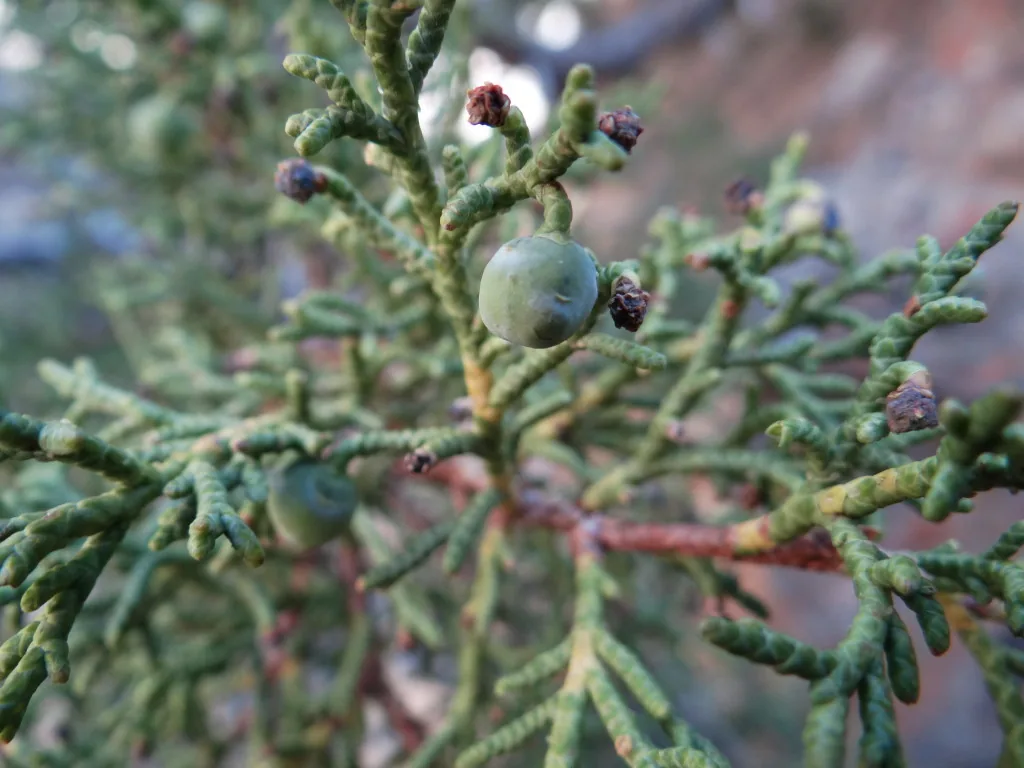
Shughnan juniper is an evergreen tree belonging to the cypress family (Cupressaceae).
It grows from 1 to 10 metres in height, and the trunk may reach 60–70 cm in thickness.
Under the conditions of Badakhshan, juniper flowers in April–May, while its seeds ripen at the end of October and in November.
The fruits become black when ripe.
The leaves on young branches are shield-shaped and oval.
The flowers are bisexual, while the cones are black and spherical and contain 2–4 seeds.
The branches and fruits have a pleasant aroma.
Shughnan juniper grows in the districts of Badakhshan — Darvoz, Vanj, Shohdara, and Ishkashim — on mountain slopes, in the mountains, and in valleys at elevations of 1,800–3,500 metres above sea level.
In the past, the people of Badakhshan regarded the juniper tree as sacred and considered cutting it down a sin.
The wood was used to make decorative objects, rubabs, tamburs, flutes, bowls, karsons, and other items.
Parts used
The branches and fruits of juniper are used for medicinal purposes.
The fruits are collected in November–December.
The collected fruits are dried in special dryers at a temperature of +40–60°C.
The dried material is stored in bags or boxes for 1–2 years.
Chemical composition
The branches and seeds of juniper contain vitamin C and essential oils.
The fruits contain:
- sugars;
- glycosides;
- colouring substances;
- resins;
- organic acids;
- tannins.
The listed trace elements in juniper fruits include:
- K;
- Ca;
- Mg;
- Zn;
- Cr;
- Al;
- Ni;
- Sr;
- Pb;
- B.
Medicinal properties
The fruits and branches of juniper are attributed the following properties:
- bactericidal;
- anti-inflammatory;
- antimicrobial;
- strengthening;
- laxative;
- anticonvulsant;
- fever-reducing;
- carminative;
- choleretic;
- expectorant;
- diuretic;
- stimulating;
- calming to the nervous system.
Use in medicine
In modern and folk medicine, juniper needles and fruits are used.
The fruits are more often used in combination with other medicinal plants.
An infusion of juniper fruits is used for disorders of the digestive system, as an appetite stimulant, choleretic, bile-forming, and digestion-supporting remedy.
It is also used for:
- inflammation of the stomach and intestines;
- liver disorders;
- gallbladder disorders.
Juniper infusion is also used for chronic diseases of the respiratory system.
These include:
- inflammation of the larynx;
- inflammation of the trachea;
- inflammation of the throat.
It is also used for certain disorders of the urinary and reproductive system:
- chronic inflammation of the renal pelvis (pyelitis);
- chronic inflammation of the renal pelvis, calyces, and kidney tissue (pyelonephritis);
- chronic inflammation of the bladder;
- kidney stone disease during periods of reduced disease activity.
External use
A decoction of juniper fruits and branches is used in baths for skin conditions.
These include:
- eczema;
- skin itching;
- rashes;
- acne;
- hair loss;
- inflammation of the skin.
It is also used for some disorders of the musculoskeletal system:
- rheumatism of the joints;
- rheumatic conditions;
- gout;
- wounds;
- sores.
Use in Badakhshan
In Badakhshan, juniper fruits and branches are used for influenza and inflammatory conditions of the respiratory organs.
They are burned slowly and the smoke is inhaled.
Juniper is also burned to disinfect homes and as a means of calming the nervous system.
In addition, the fruits and branches of juniper are mixed with harmala, immortelle, a small amount of flour, and oil, then burned slowly as a fragrant incense in homes.
On Friday nights, households are fumigated with this mixture for disinfection and in remembrance of angels and the spirits of deceased relatives.
Fragrant smoke is also burned during the holidays of Kurbon and Ramadan, at shrines and burial places for the same purpose.
Medicinal forms, method of use, and dosage
Infusions and decoctions are prepared from juniper fruits and branches.
They are used both separately and in combination with other medicinal plants.
Juniper infusions and decoctions are used both internally and externally.
Juniper infusion
To prepare the infusion, 15 g, or three teaspoons, of juniper fruits and branches are placed in a suitable container and covered with 200 ml, or one glass, of boiling water.
The mixture is heated in a water bath for 15 minutes.
It is then cooled at room temperature for 45 minutes.
Afterwards, it is strained through 2–3 layers of gauze.
The remaining plant material is pressed, and the volume of the infusion is restored to 200 ml.
It is taken in an amount of one tablespoon 3 times a day, half an hour before meals.
The infusion is stored in a dark, cool place.
The storage period is two days.
Bath
200 g of juniper fruits are infused in one litre of cold water for 2 hours.
They are then boiled over low heat for 10–15 minutes.
The decoction is strained through gauze, the remaining material is pressed, and the liquid is added to bath water.
This method is used for skin disorders and conditions of the musculoskeletal system.
Contraindications
Because of the stimulating properties attributed to juniper, it is not recommended for acute disorders of the urinary and reproductive system.
These include:
- acute inflammation of the kidneys (nephritis);
- acute inflammation of the bladder;
- nephrosis;
- acute inflammation of the renal pelvis, calyces, and kidney tissue (pyelonephritis).
In chronic conditions mentioned above, the stated dosage of juniper infusion should be strictly observed.
Juniper infusion is contraindicated for people with gastric and duodenal ulcers, inflammation of the stomach, and generalised oedema (dropsy).
Its use is also contraindicated during pregnancy.
Juniper is classified as a poisonous plant.
Warning
Information about medicinal properties, methods of use, and dosages on this page comes from the source text and partly belongs to traditional medicine.
Because juniper is described in the text as a poisonous plant and has a number of contraindications, this information should not be used as a guide to self-treatment.
The information is provided for educational and informational purposes.