
Names
Tajik: Ҷағ-ҷағ (ҷағ-ҷағак, каҳак, ҷа-ҷа, ҷагак, халтаи лӯлӣ, ҷӯгихалта, шабушкушак)
Latin: Capsella bursa-pastoris L. Medic.
Russian: Пастушья сумка (воробьиная кашка, горобинье очко, режуха, сумочка, сердочки, горобинец, дикарка, забируха, зозульник, калитник)
Wakhi: Къшкрич
Shughni-Rushani: Мастак вохъ
English: Capsella
Description
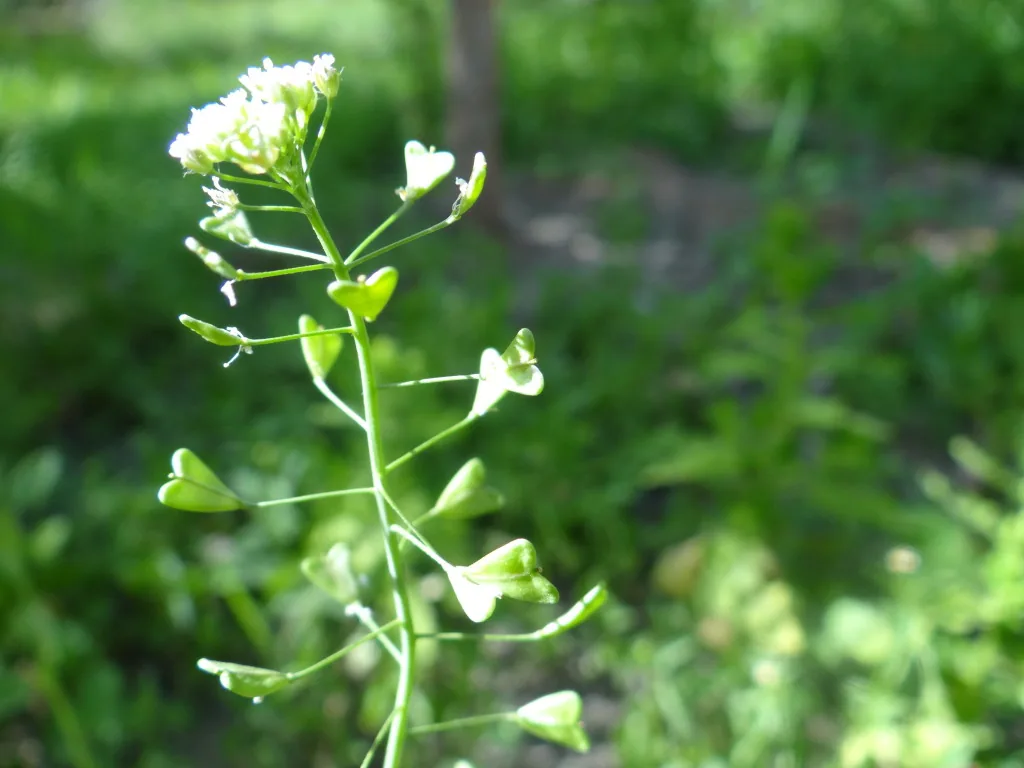
Shepherd’s purse is an annual herbaceous plant belonging to the mustard family (Brassiceae).
Its stem is upright, sparsely branched, single or several in number, and reaches up to 90 cm in height.
The basal leaves reach 15–20 cm in length and 3–4 cm in width.
The upper stem leaves are relatively small, reaching up to 7 cm in length and 1–1.5 cm in width.
The flowers are small and white.
The fruits contain many seeds and are triangular and heart-shaped.
The seeds are small and brown.
Shepherd’s purse flowers in May–June, and its fruits ripen in July–August.
The plant grows in gardens, vegetable plots, along roads, in damp places, and along irrigation channels at elevations of 1,800–3,600 metres above sea level.
Its nature is considered dry in the first degree and cold in the third degree.
Parts used
The above-ground part of the plant is used for medicinal purposes.
It is collected during flowering, in dry weather, after the dew has dried, and then dried in a shaded, well-ventilated place.
The plant should not be collected after the fruits have fully ripened.
The dried material is stored in special bags or cardboard boxes for up to 3 years.
Chemical composition
The leaves and stems contain:
- vitamin C — 120–177.5 mg%;
- carotene — 4.7 mg%;
- soluble sugars — 2.60 mg%;
- cellulose — 29.52 mg%;
- protein — 19.69%;
- protein substances — 16.19 mg%;
- fat — 1.99;
- ash;
- vitamins K, B2, and P;
- tannins;
- essential oil;
- malic, citric, and fumaric acids;
- choline;
- acetylcholine;
- saponins;
- steroids;
- flavonoids, including rutin, diosmin, 7-rutinoside, luteolin, and others.
The leaves also contain the following macroelements:
- K;
- Ca;
- Mg;
- Fe.
The listed trace elements include:
- Mn;
- Cu;
- Zn;
- Co;
- Mo;
- Sn;
- V;
- Ba;
- Se;
- Ni;
- Sr;
- Pb;
- Ti;
- Br;
- B.
(Azonzod J. 2010; Khaitov I. 2004; Kurennov I. 2008).
Medicinal properties
Shepherd’s purse is attributed mild hypotensive and haemostatic properties.
It is also considered to increase the tone of the uterine muscles.
Use in medicine
Shepherd’s purse has been used for its haemostatic properties and its ability to cause contraction of the uterine muscles.
For this reason, it has been used in connection with meno-metrorrhagia — heavy menstruation and irregular uterine bleeding accompanied by disturbances of the menstrual cycle.
It is also used in cases of:
- bleeding after abortion;
- bleeding after childbirth;
- pulmonary bleeding;
- kidney bleeding.
In some cases, shepherd’s purse is used together with horsetail and under medical supervision.
Use in the medicine of different countries
In the medicine of Poland, Bulgaria, and France, the plant is used as a haemostatic remedy for:
- pulmonary bleeding;
- uterine bleeding;
- stomach bleeding;
- irregular menstruation.
It is also used as a remedy for lowering elevated arterial blood pressure.
Use in folk medicine
In folk medicine, shepherd’s purse is used for:
- bleeding from the lungs;
- bleeding from the stomach;
- uterine bleeding;
- kidney bleeding;
- injuries.
A decoction of the fresh herb is used for liver and kidney disorders and disturbances of metabolism.
It is also used for:
- haemorrhoids;
- kidney stones;
- inflammation of the bladder.
An alcoholic tincture is used as a sleeping remedy in cases of nervous system disorders and to reduce excessive emotional excitement.
An infusion of the herb is used externally for injuries and wounds in the form of compresses and dressings.
(Kovaleva N. G. 1971; Kurennov I. 2008).
Medicinal forms, method of use, and dosage
Shepherd’s purse herb decoction
2 tablespoons of the herb are placed in an enamelled container and covered with 200 ml, or one glass, of boiling water.
The mixture is boiled over low heat or in a water bath for 15 minutes.
It is then cooled at room temperature for 45 minutes.
Afterwards, it is strained through gauze, the remaining plant material is pressed, and the volume of the decoction is restored to the original amount.
It is taken in an amount of one tablespoon 4–5 times a day after meals.
The decoction is used as a haemostatic remedy.
Shepherd’s purse herb infusion as a choleretic and diuretic
40–50 g of the material are infused in 1 litre of boiling water for 30 minutes.
The infusion is then strained through gauze, and the remaining plant material is pressed.
It is taken in an amount of half a glass 3 times a day before meals.
Shepherd’s purse herb infusion for external use
3 tablespoons of the material are infused in one glass of water at room temperature for 8 hours.
The infusion is then strained.
It is used for compresses and for washing wounds and sores.
Pharmaceutical preparations
Shepherd’s purse herb is produced in packages of 75 g.
A liquid extract of shepherd’s purse is produced in 25 ml bottles and is taken in amounts of 20–25 drops.
Warning
Information about medicinal properties, methods of use, and dosages on this page comes from the source text and partly belongs to traditional and folk medicine.
Some of the described uses concern uterine bleeding, bleeding after childbirth or abortion, and other serious conditions and should not be used as a guide to self-treatment.
The information is provided for educational and informational purposes.