Names
Tajik: Себаргаи сурх (себаргаи чаманӣ, себарга, хандакук, девсӯпӯст, хандақуқӣ)
Latin: Trifolium pratense L.
Russian: Клевер красный (клевер луговой, диатлина красная, красноголовник, красная кошка, медовый цвет, трёхлистник, троица)
Ishkashimi: Себарга
Wakhi: Шафтал
Shughni-Rushani: Шафтал
Yazgulami: Рушт садбарг
English: Clover
Description
Red clover is a perennial herbaceous plant belonging to the legume family (Leguminosae).
Its stem is upright or ascending, simple or branched, and reaches 15–60 cm in height.
The leaf consists of three leaflets, which is reflected in the Tajik name of the plant — себарга.
The leaflets are elliptical and are arranged successively near the ends of the stems.
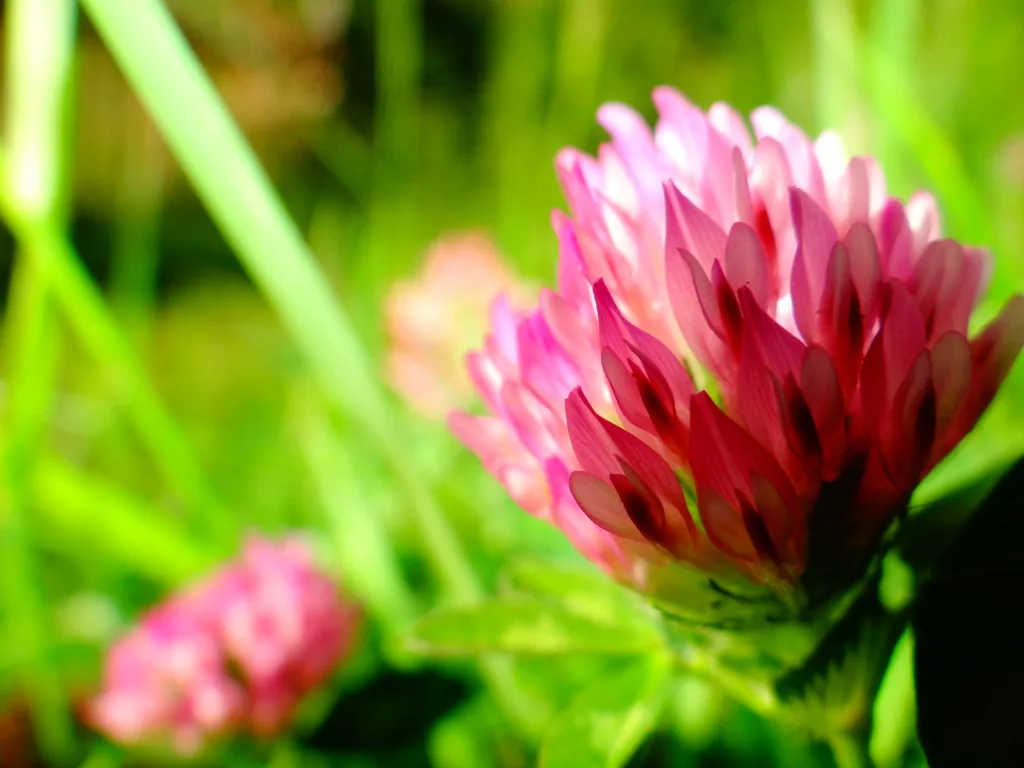
The flowers are red or pink and are gathered into many-flowered heads.
The fruit contains one seed and is elliptical or elongated-ovoid in shape.
The seeds are very small and red or violet in colour.
Red clover flowers from May to August, and its seeds ripen in September–October.
In Badakhshan, red clover grows in all districts except Murghab, at elevations of 1,700–3,000 metres above sea level, along riverbanks, in vegetable plots, gardens, and moist places.
Its nature is considered hot in the second degree and dry in the first degree.
Red clover is a honey plant.
Parts used
In medicine, mainly the flower heads and upper leaves of red clover are used.
Medicinal material is collected during the flowering season.
The collected material is dried outdoors, in the shade, or in special dryers at a temperature of 40–60°C.
The dried material is stored in special bags, wooden boxes, or cardboard boxes for up to 2 years.
Chemical composition
The flowers and herb of red clover contain:
- trifolin and isotrifolin glycosides;
- essential oils;
- coumaric and salicylic acids;
- sitosterols;
- heptonic substances;
- coumarins;
- vitamins C, B, E, and K;
- carotene;
- fatty oils;
- tannins;
- the flavonoid quercetin;
- asparagine;
- tyrosine.
The leaves contain vitamin C and trifolysin substances.
(Khojimatov I. 1989; Kurennov I. 2008; Khaitov I. 2004).
Medicinal properties
Red clover is attributed the following properties:
- antiseptic;
- anti-inflammatory;
- antibacterial;
- expectorant;
- diuretic;
- diaphoretic;
- astringent;
- haemostatic.
Use in medicine
Red clover is not used in scientific medicine.
According to N. G. Kovaleva (1971), an alcoholic tincture of red clover was used for circulatory disorders, dizziness, headache, and ringing in the ears when blood pressure was normal.
The author gives the following method of preparation:
40 g of the leafless tops of the plant, collected during flowering, are infused in 50 ml of 40% alcohol for 10 days and then strained.
The tincture is taken in an amount of 20 ml before lunch or before sleep.
The course of treatment lasts 3 months, with a 10-day break between each month.
The treatment is repeated after 6 months.
Use in ancient medicine
Avicenna used red clover for stomach pain, bladder disorders, swellings, and as a diuretic and menstruation-stimulating remedy.
Red clover juice was used to cleanse purulent wounds and, together with honey, for treating an eye opacity and the site of a scorpion sting.
Use in folk medicine
In folk medicine, red clover infusion and tea are used for inflammation of the mucous membranes of the mouth, nose, and intestines.
It is also used as an expectorant, diaphoretic, and diuretic remedy for inflammation of the respiratory passages, trachea, lungs, and for asthma.
Decoctions and infusions of the flowers and leaves are used to improve appetite and in connection with:
- tuberculosis;
- malaria;
- migraine;
- uterine bleeding;
- painful menstruation;
- anaemia;
- headache;
- jaundice;
- intestinal colic;
- kidney colic.
An alcoholic tincture of red clover is used for circulatory disorders.
The juice of the flowers was used for washing the eyes.
Fresh leaves are applied to sores, ulcers, burns, and wounds as a wound-healing dressing.
Culinary use
The leaves and flowers of red clover are used to prepare sambusa and mantu.
They are also added to soups as greens and used together with other edible plants.
Medicinal forms, method of use, and dosage
Red clover is used alone and in combination with other medicinal plants in the form of infusions, decoctions, and tinctures.
Infusion of red clover flowers and leaves
20 g of flowers and leaves, or one tablespoon, are infused in 200 ml, or one glass, of boiling water for 6–8 hours and then strained.
It is taken daily in an amount of 1/3 of a glass, 30 minutes before meals.
Decoction of red clover herb
20 g, or one tablespoon of medicinal material, are placed in an enamelled container and covered with 200 ml, or one glass, of boiling water.
The mixture is boiled for 15 minutes over low heat or in a water bath and then infused for 30 minutes.
It is then strained through 2–3 layers of gauze.
The remaining plant material is pressed.
The volume of the decoction is restored to its original amount.
The decoction is used for compresses and for rinsing the mouth.
Alcoholic tincture of red clover herb
40 g, or two tablespoons of material, are mixed with 500 ml of 40% alcohol and infused for 10 days.
After straining, the tincture is taken in an amount of 20 ml before lunch or before sleep for 3 months.
A 10-day break should be taken between each month.
The tincture is used for circulatory disorders.
(Kovaleva N. G. 1974).
Warning
Information about medicinal properties, methods of use, and dosages on this page comes from the source text and traditional medicine.
Some methods, including use for bleeding, eye conditions, and other serious health problems, should not be regarded as a guide to self-treatment.
The information is provided for educational and informational purposes.