
Names
Tajik: Тамашк (тути фарҳангӣ)
Latin: Rubus idaeus L.
Russian: Малина обыкновенная
English: Red raspberry
Description
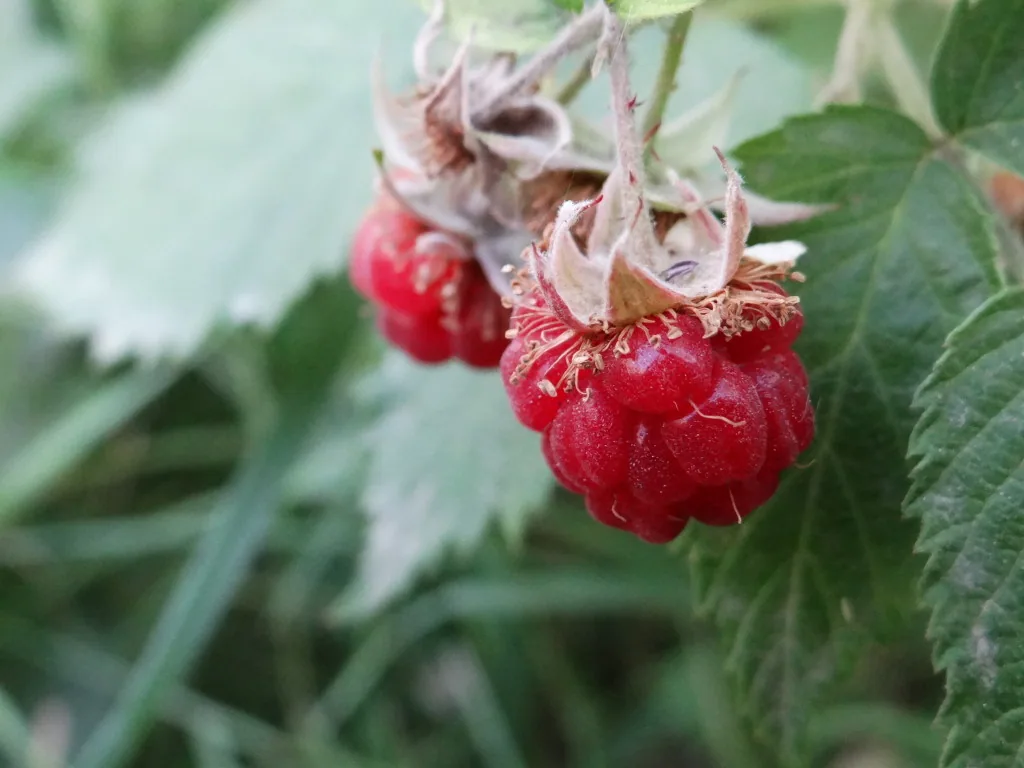
Red raspberry is a berry-producing shrub belonging to the rose family (Rosaceae).
Its upright, strongly branched, thorny shoots reach up to 2 metres in height.
The underground part consists of a main root and numerous lateral roots.
The above-ground part is formed by one- and two-year-old shoots.
The leaves are compound and consist of 3–7 oval or rounded leaflets.
The inflorescence contains 10–20 flowers.
The flowers are white and bloom for the first time in April–June and for a second time in August–September.
The fruits are red or yellow, pleasant-tasting, aromatic, and juicy.
Raspberry grows well in the districts of Badakhshan except Murghab.
It is propagated vegetatively.
Seeds are used only for developing new varieties.
Raspberry is a honey plant.
Its nature is considered cold and dry in the second degree.
Parts used
The fruits, flowers, and leaves of raspberry are used for medicinal purposes.
The fruits are collected after ripening in July–September.
They are dried in the sun or in drying equipment.
The dried fruits are stored in boxes for up to 2 years.
The leaves and flowers are collected in June–August and dried in a shaded, well-ventilated place.
Chemical composition
Raspberry fruits contain:
- sugars — fructose, sucrose, glucose;
- organic acids — citric, malic, oxalic, salicylic, formic, and caproic acids;
- coumarins;
- pectic substances;
- purines;
- vitamins C, A, E, B1, B2, B6, and B12;
- essential oil;
- quercetin flavonoids;
- 3-galactoside;
- anthocyanins.
The leaves contain the following macroelements:
- K;
- Ca;
- Mg;
- Fe.
The listed trace elements include:
- Mn;
- Cu;
- Zn;
- Co;
- Mo;
- Al;
- Ni;
- Pb;
- Sr;
- Se;
- B.
(Nuraliev Y. 1989; Azonzod J. 2010).
Medicinal properties
Raspberry is attributed the following properties:
- diaphoretic;
- fever-reducing;
- pain-relieving;
- anti-inflammatory;
- calming;
- astringent.
Use in medicine
In folk medicine, raspberry fruits, leaves, and flowers are widely used.
Fresh fruits, jam, and syrup are used for colds and infectious diseases.
These include:
- inflammation of the respiratory passages;
- inflammation of the trachea;
- sore throat;
- inflammation of the lungs and throat;
- inflammation of the frontal sinuses.
Raspberry is also used as an astringent and anti-inflammatory remedy for acute and chronic inflammation of the stomach, inflammation of the oral mucosa, bloody diarrhoea, blood-filled swellings, and skin eruptions.
In modern medicine, raspberry fruits in the form of jam and syrup are used for iron-deficiency anaemia, infectious diseases, as an appetite stimulant and fever-reducing remedy, and for diseases of the stomach and intestines.
In combination with other medicinal plants, raspberry is used in connection with diabetes, infectious diseases, joint pain, and malaria.
Fresh leaves are applied to wounds, sores, and eczema.
(Nuraliev Y. 1989; Azonzod J. 2010).
Medicinal forms, method of use, and dosage
Raspberry flower infusion
20 g, or one tablespoon of the material, are placed in an enamelled container and covered with 200 ml, or one glass, of boiling water.
The mixture is infused for 30 minutes and then strained through gauze.
It is taken in an amount of one tablespoon 3–4 times before meals.
The infusion is used for colds.
Infusion of dried raspberry fruits
10 g of dried fruits are placed in an enamelled container and covered with 200 ml, or one glass, of boiling water.
The mixture is infused for 20 minutes and then strained.
It is drunk hot in an amount of one glass.
The infusion is used as a diaphoretic.
Raspberry leaf infusion
4 teaspoons of leaves are infused in 200 ml of boiling water for 30 minutes.
The mixture is then strained and the plant material is pressed.
It is taken in an amount of half a glass 4 times a day before meals.
Raspberry leaf decoction
10 g of plant material are placed in 200 ml, or one glass, of water and boiled for 10 minutes in a water bath or over low heat.
It is then cooled and strained.
The decoction is used as a compress for skin eruptions on the face and dry swellings.
Raspberry juice
Raspberry juice is taken in an amount of 0.5 glass 3 times a day for stomach pain and colds.
For инъисоб and alcohol poisoning, an amount of one glass is taken.
Warning
Information about medicinal properties, methods of use, and dosages on this page comes from the source text and partly belongs to folk medicine.
The information is provided for educational and informational purposes and should not be used as a guide to self-treatment.