
Names
Tajik: Гули ғозӣ (гиёҳи ҳамешаҷавон, ғози чой)
Latin: Helichrysum arenarium L. Moench (Anaphalis virgata Thoms)
Russian: Бессмертник песчаный (анафалис прутьевидный)
Arabic: Хаюлолам
Ishkashimi: Арақи Расул
Wakhi: Арақи Расул
Shughni-Rushani: Стирахм, буйвохъ
Yazgulami: Нахчирвехъ
English: Immortelle, strawflower
Description
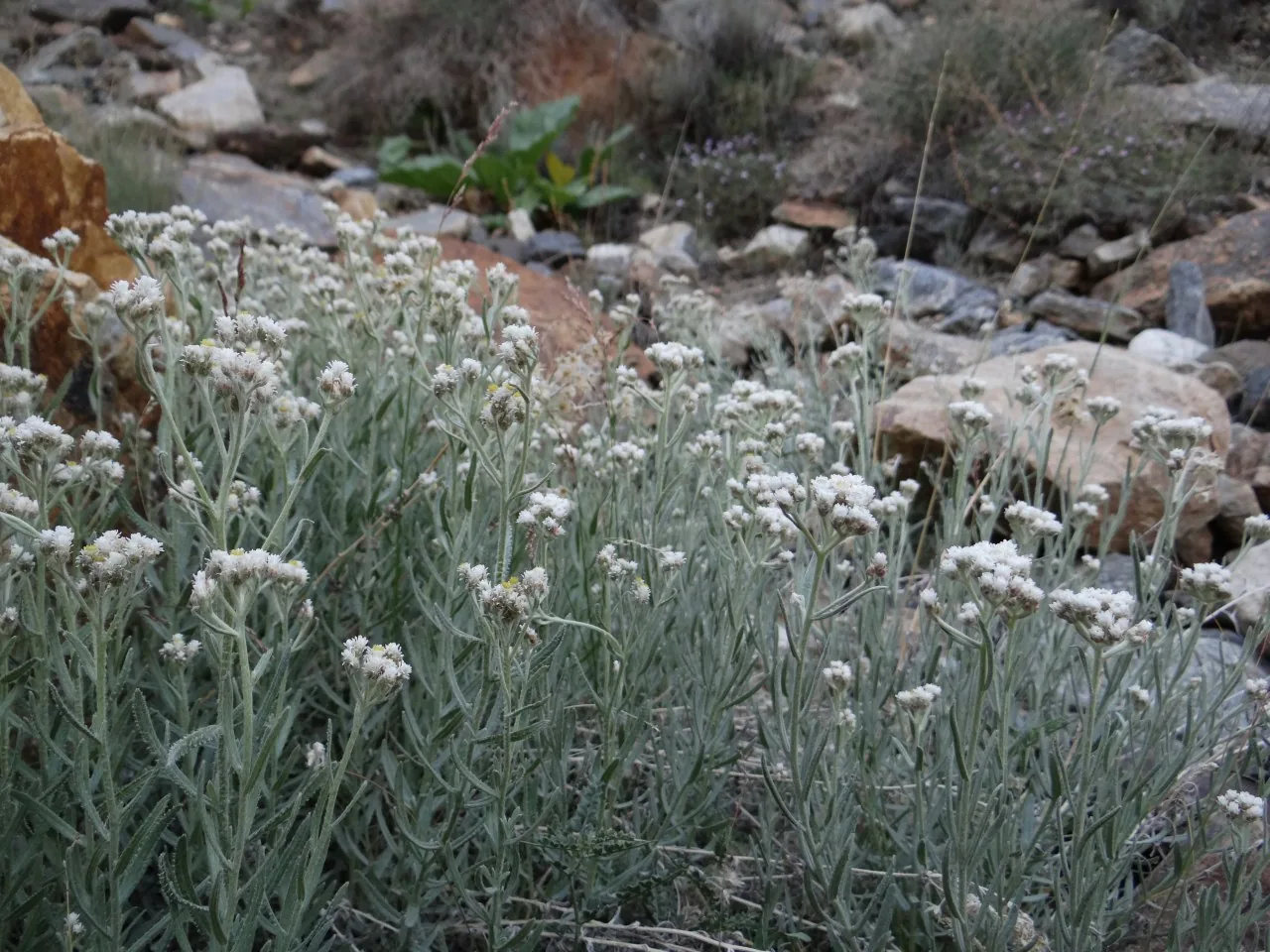
Immortelle is a perennial herbaceous plant belonging to the Compositae family.
The plant grows to a height of approximately 20–50 cm. Its leaves are arranged alternately, have an elongated shape, and reach about 2–6 cm in length.
The flowers are yellow or pinkish and form rounded flower heads. The plant blooms in June–July, while its seeds ripen in August–September.
In Badakhshan, immortelle grows along watercourses, on summer pastures, slopes, ravines, and open areas at elevations of approximately 2,000–3,500 metres above sea level.
Chemical composition
According to the source material, immortelle contains flavonoids, including heliparin, carilin up to 4%, essential oils about 0.05%, sugars 1.2%, resins 3.66%, sterols 0.05%, tannins, and mineral salts.
The listed macronutrients include K, Ca, Mg, and Fe.
The listed trace elements include Mn, Co, Cu, Zn, Mo, Cr, Al, Se, Ni, Pb, Ir, B, and Br.
The source also mentions the presence of vitamins C and K.
The original material cites works by V. G. Kukes (1999), A. D. Turova (1974), and A. Mamadrizokhonov (1998).
Medicinal properties
The source material attributes sedative, restorative, anti-inflammatory, antibacterial, antispasmodic, and choleretic properties to immortelle.
It also states that galenic preparations of the plant may influence bile secretion and the smooth muscles of the gallbladder, bile ducts, intestines, and blood vessels.
The source also mentions effects on cholesterol and bilirubin levels in the blood.
Use in medicine
The source material mentions the use of immortelle in connection with inflammatory diseases of the liver, gallbladder, and bile ducts, gallstone disease, certain diseases of the kidneys and genitourinary system, as well as some disorders of the stomach and intestines.
It also describes the use of the flower heads in Bulgaria for conditions related to the gallbladder, kidneys, and urinary bladder.
In Germany, according to the source, immortelle has been used for diseases of the liver and urinary bladder, as well as as an appetite-stimulating remedy and for stomach disorders.
The original material cites works by N. G. Kovalyova (1974) and S. Ya. Sokolov (2000).
Medicinal forms and preparation methods
The original material provides several methods for preparing infusions and decoctions of immortelle.
Infusion
10 g of flowers are placed in an enamelled container, covered with 200 ml of boiling water, and infused for approximately one hour.
The infusion is then strained through several layers of gauze, and the plant material is pressed.
The source states that the infusion is taken in an amount of half a glass three times a day, approximately 30 minutes before meals.
Infusion for kidney conditions
10 g of flowers are mixed with approximately 400 ml of boiling water, heated in a water bath for about 10 minutes, and then infused for approximately 30 minutes.
After straining, the source recommends taking the infusion warm several times a day before meals.
Infusion for stomach conditions
15 g of plant material are covered with approximately 0.5 litres of cooled boiled water and infused for 2–3 hours.
After straining, the original material states that half a glass is taken four times a day, approximately 30 minutes before meals.
Decoction as a choleretic preparation
30 g of plant material are mixed with 200 ml of boiling water and heated in a water bath for approximately 30 minutes.
The decoction is then cooled at room temperature for about 10 minutes, strained, and the volume of liquid is restored to its original amount.
The source states that half a glass is taken 2–3 times a day, 15–20 minutes before meals.
Pharmaceutical preparations
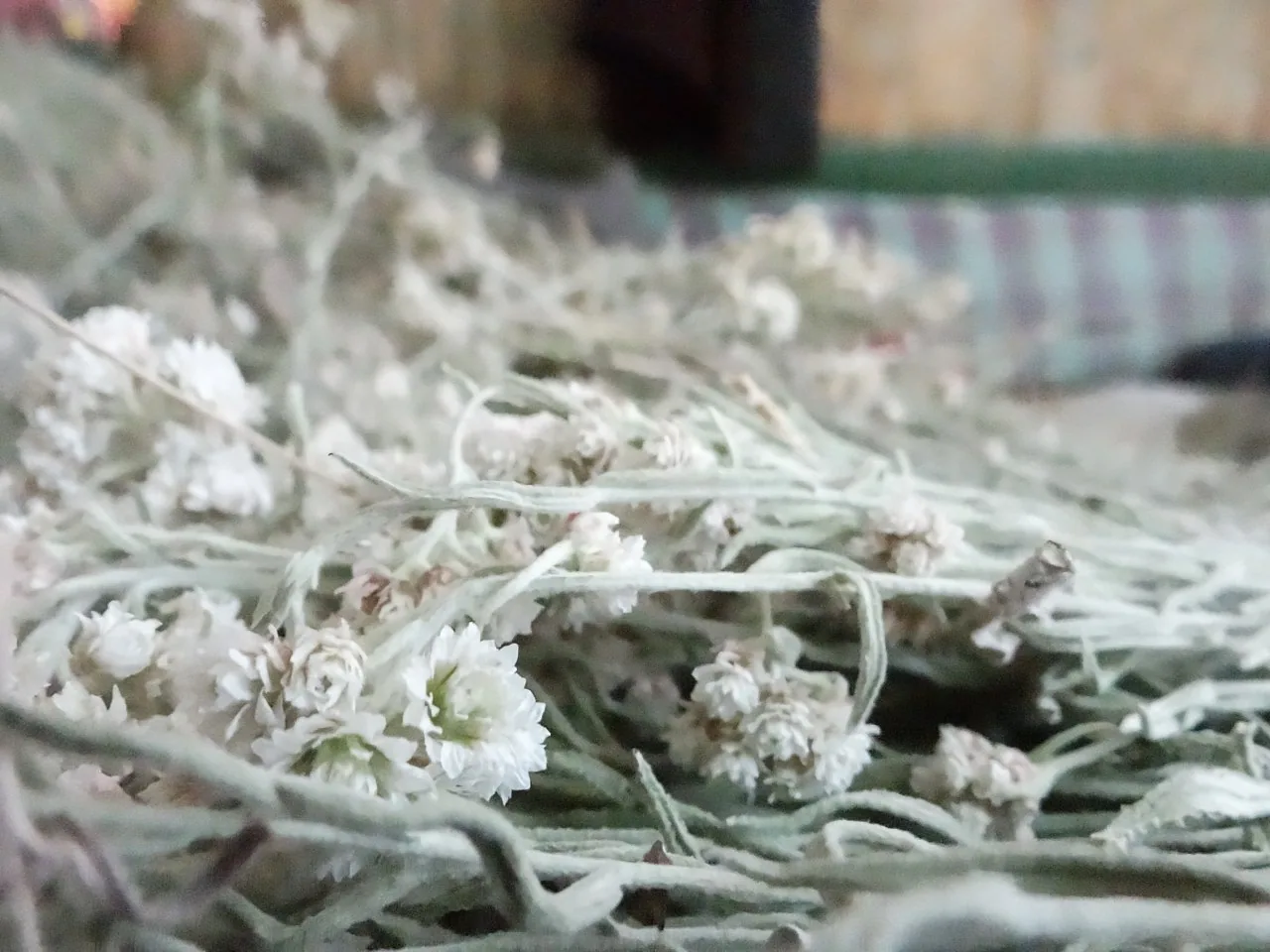
The original material mentions pharmaceutical forms of immortelle, including dried flowers, extract, and granules.
It also names the preparations “Flamin” and “Arenarin”.
According to the source, “Flamin” is associated with use for gallbladder conditions and impaired bile flow, while “Arenarin” is described as having antimicrobial properties and being used for certain eye injuries.
Important note
The information on this page is based on the provided material concerning the traditional and medicinal use of immortelle and is presented for educational and informational purposes.
It is not individual medical advice and should not be used as instructions for self-treatment.