Names
Tajik: Сипандона (сипанд, сипандон, испанд, испандон, исриқ, алафи балогардон, ҳазориспанд, ҳазораспанд, ҳармал)
Latin: Peganum harmala L.
Russian: Гармала обыкновенная (могильник, адраспан, белобок, бибик, гарьман, дикая рута, собакария, собачье зелье, стебная рута)
Arabic: Ҳармал
Ishkashimi: Спанд, спандона
Wakhi: Спандр, спандона
Shughni-Rushani: Сипанд, сипандона
Yazgulami: Спандан
English: Syrian rue
Description
Syrian rue is a perennial plant belonging to the Zygophyllaceae family.
Its stems grow to approximately 20–30 cm in height. The root may reach a depth of up to 2–3 metres.
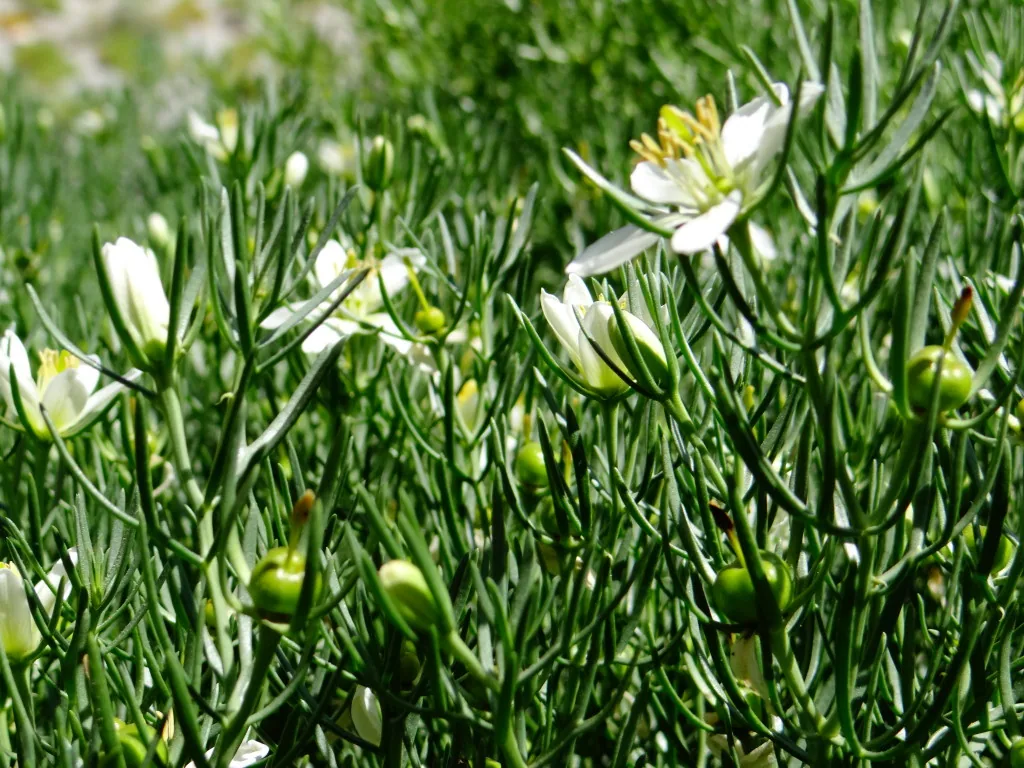
The plant has numerous upright, highly branched, smooth stems.
Its leaves are approximately 3–6 cm long and are divided into narrow segments.
The white flowers are usually borne singly on flower stalks.
The calyx is approximately 1.5–2.5 cm long, while the petals are about 1.5–2 cm in length.
The seeds are numerous and develop inside a capsule. In the original material, their length is given as approximately 0.3 mm. Their colour is described as white or yellowish-white.
Syrian rue grows on sandy and clay soils, along roads, in dry channels, cemeteries, and other relatively dry places.
In Badakhshan, it occurs at elevations of approximately 1,800–3,200 metres above sea level and is found in all districts except Murghab.
Syrian rue is a poisonous plant.
Parts used
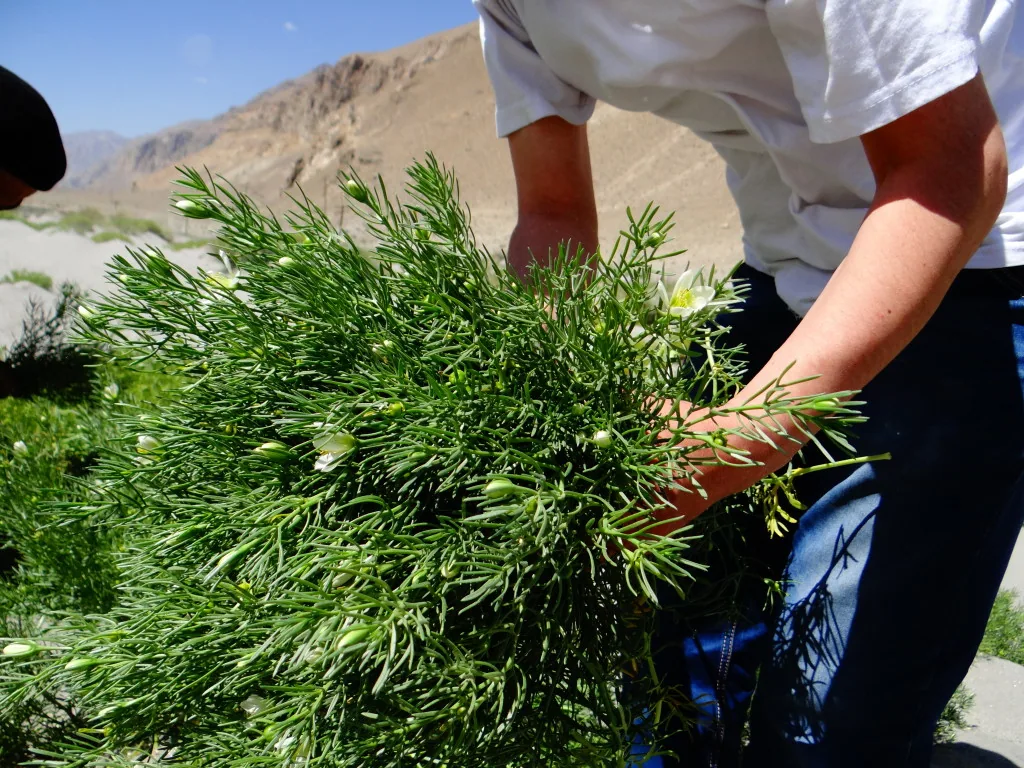
For medicinal purposes, the above-ground part of the plant is used.
The plant material is collected during the budding stage, before flowering.
The stems are cut with a sickle or another suitable tool and dried quickly outdoors in the shade.
The seeds are collected in autumn after they have fully ripened.
The herb and seeds are used as sources of alkaloids such as peganine, harmine, and other compounds.
The dried material is stored in special bags, cardboard boxes, or wooden containers for up to two years.
Chemical composition
The original material states that Syrian rue contains a considerable amount of alkaloids.
Their content is given as follows:
- roots — 1.5–3.5%;
- leaves — 1–5%;
- flowers — 2–3%;
- seed capsules — 1.58%;
- seeds — 2.8–5%.
Alkaloids isolated from the plant include harmine, harmaline, harmalol, peganine, vasicinone, deoxyvasicinone, deoxypeganine, peganidine, peganol, pegamon, dipegin, quinoline, quinaldine, and other compounds.
The original material states that a total of 17 alkaloids were identified.
In addition to alkaloids, the seeds are described as containing a red colouring substance and approximately 10–25% drying fatty oil.
The original material cites works by M. Khodzhimatov (1989), I. Khaitov (2004), and D. A. Muravyova (1991).
Medicinal properties
The original material states that 1% and 10% infusions of the above-ground parts of Syrian rue have antistaphylococcal properties.
It also states that solutions of peganine and peganidine have pronounced antimicrobial activity.
Among the alkaloids present in the herb and seeds, the source gives particular importance to peganine.
The original material attributes tonic, laxative, choleretic, diaphoretic, and anthelmintic effects to peganine.
Use in medicine
The original material states that Avicenna used Syrian rue in connection with joint pain, certain eye diseases, intestinal colic, haemorrhoids, and as a diuretic and emmenagogue.
In traditional medicine, Syrian rue has been used in connection with bronchial asthma, shortness of breath, rheumatism, and also as a calming, choleretic, diuretic, and diaphoretic remedy.
The source also mentions its use in connection with certain skin diseases, frostbite, malaria, epilepsy, and other conditions.
Among Tajik communities, the seeds of Syrian rue have traditionally been burned as incense in homes and around sick people. In the original material, this practice is associated with conditions such as epilepsy, paralysis, fainting, and severe fright.
In Badakhshan, the seeds and herb have also been burned or otherwise used in connection with some cold-related illnesses, inflammation of the respiratory organs, fear, anxiety, and insomnia.
The original material also describes a cultural practice in which Syrian rue, immortelle, fruits and leaves of mountain juniper were taken in equal proportions and mixed with flour and oil to make an aromatic mixture.
This mixture was burned on Friday evenings, during the holidays of Kurban and Ramadan, in homes, buildings, at thresholds, and at places associated with deceased relatives. In the source, this practice is connected with remembrance of ancestors and wishes for the health of the family.
Use in modern medicine
The original material states that the alkaloid peganine has been used in connection with some cases of myopathy and myasthenia.
It also mentions its use as a laxative in certain conditions associated with reduced intestinal activity.
Baths prepared from a decoction of the above-ground parts of Syrian rue are mentioned in connection with certain skin diseases, rheumatism, gout, and inflammation of the joints.
Medicinal forms, preparation, and dosage
The original material provides several methods of using Syrian rue.
Infusion of Syrian rue seeds
5 g, or approximately one teaspoon of seeds, are infused in 400 ml of boiling water for about 30 minutes.
The infusion is then cooled for approximately 10 minutes and strained through 2–3 layers of gauze.
The original material states that one tablespoon is taken three times a day before meals.
Use of the seeds
The source also mentions taking 10–15 Syrian rue seeds three times a day before meals.
Bath
10 g of the herb are boiled in 1 litre of water for approximately 10–15 minutes.
The decoction is then strained and added to bath water.
The original material gives a water temperature of approximately +37–40°C and a duration of 10–15 minutes.
The source also mentions a course of up to 10 baths.
This form of use is associated in the original material with certain skin diseases, rheumatism, gout, inflammation of the joints, and itching of the skin.
Warning
Syrian rue is explicitly described in the original material as a poisonous plant.
For this reason, the information on this page should not be treated as direct instructions for consumption, preparation, or self-treatment.
The information is presented solely for educational, historical, and informational purposes.
Any medicinal or therapeutic use of Syrian rue requires consultation with a qualified medical professional.