
Names
Tajik: Хори харак (харакхор, уштур хор, хори уштур)
Latin: Echinops maracandicus Bunge
Russian: Мордовник обыкновенный (мордовник самаркандский)
Ishkashimi: Хах
Wakhi: Путзах, путзағ
Shughni-Rushani: Жаш
English: Globe thistle
Description
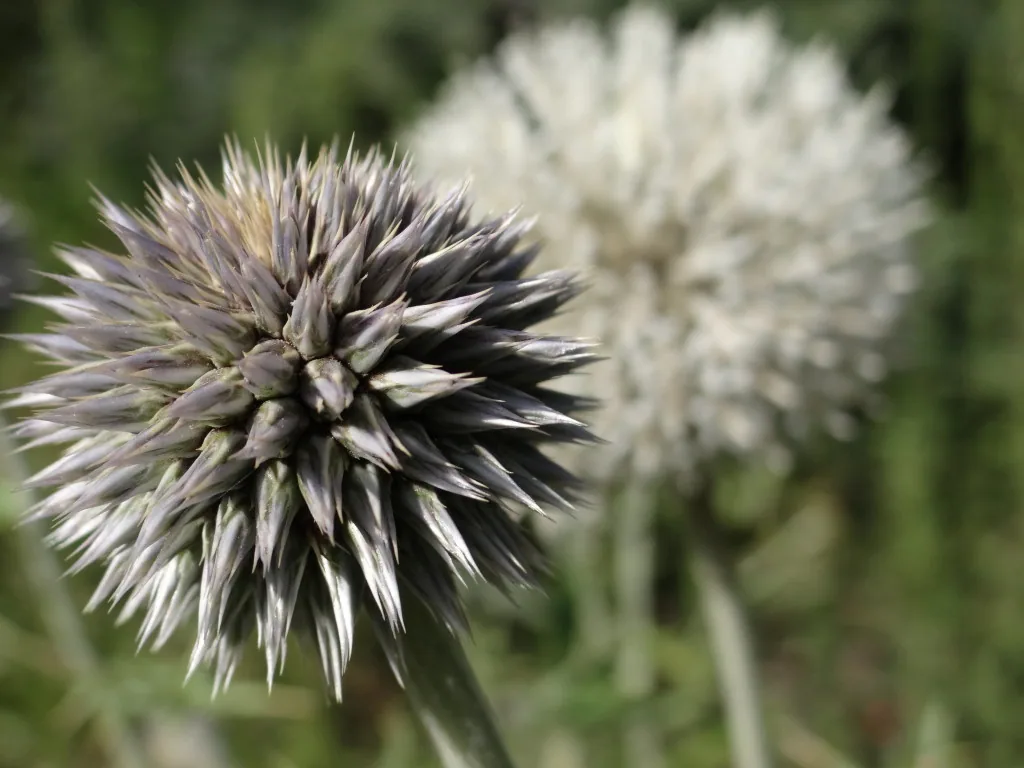
Globe thistle is a perennial plant belonging to the daisy family (Compositae).
It has a taproot of a spindle-like form.
The stem is upright, single or multiple, simple, with a small number of branches in the upper part, and reaches up to 1 metre in height.
The leaves are leathery, palm-shaped, of two types, and may be white, bluish, or greyish in colour.
The seeds are elongated, spindle-shaped, and black.
The flowers are bluish and gathered in spherical inflorescences.
Twenty-one species of globe thistle grow in Tajikistan.
The plant grows in warm regions, ravines, and on slopes at elevations of 400–2,800 metres above sea level.
Globe thistle is a honey plant and may sometimes poison livestock.
It flowers in June–July, and the seeds ripen in August–September.
Parts used
For medicinal purposes, the fruits, or seeds, of globe thistle are used.
The seeds are collected in autumn, in September–October.
They are harvested by shaking the flower heads and separating the seeds.
Chemical composition
The seeds contain the alkaloid “Echinopsine”, fatty oil, and vitamin C.
Medicinal properties
Globe thistle is attributed the following properties:
- haemostatic;
- cardiotonic;
- stimulating to nerve cells;
- diaphoretic;
- strengthening.
Use in medicine
The alkaloid echinopsine is obtained from the seeds of globe thistle.
Echinopsine has cardiotonic properties. In small amounts it raises blood pressure, while in larger amounts it lowers it.
Experiments also found that in small amounts echinopsine has a stimulating effect, while larger amounts may cause convulsions followed by depression.
The alkaloid echinopsine has been used for:
- plexitis;
- inflammation of the spinal nerve roots (radiculitis);
- atrophic paralysis of the optic nerve;
- инъисоб;
- low arterial blood pressure (hypotension);
- myopathy;
- childhood infectious paralysis (poliomyelitis).
In Chinese folk medicine, globe thistle is used as a haemostatic remedy.
In folk medicine, globe thistle is also used for:
- tuberculosis;
- inflammation of the spinal nerve roots;
- rheumatism;
- low blood pressure;
- diseases of the nervous system;
- certain skin diseases.
(Sokolov S. Y. 2000; Khaitov I. 2004; Kovaleva N. G. 1971; Turova A. D. 1974; Seredin R. M. et al. 1973).
Medicinal forms, method of use, and dosage
0.4% sodium echinopsine solution
A 0.4% sodium echinopsine solution is produced in 1 ml ampoules.
It is administered subcutaneously twice.
The treatment course lasts 20–30 days.
This solution is used for optic nerve atrophy.
1% sodium echinopsine solution
A 1% sodium echinopsine solution is produced in 20 ml bottles.
It is taken in amounts of 10–20 drops twice a day, 15–20 minutes before meals.
Warning
Information about medicinal properties, methods of use, and dosages on this page comes from the source text and partly concerns traditional medicine and preparations containing the alkaloid echinopsine.
Echinopsine may affect blood pressure and the nervous system, so the information on this page should not be used as a guide to self-treatment.
The material is provided for educational and informational purposes.