Names
Tajik: Зардпечак
Latin: Cuscuta europaea et Cuscuta epithymum Murr.
Russian: Повилика
Arabic: Афитимун, кушус
Ishkashimi: Зардчечык
Wakhi: Варми
Shughni-Rushani: Зардпечак
Yazgulami: Вырдонг
English: Dodder, strangleweed
Description
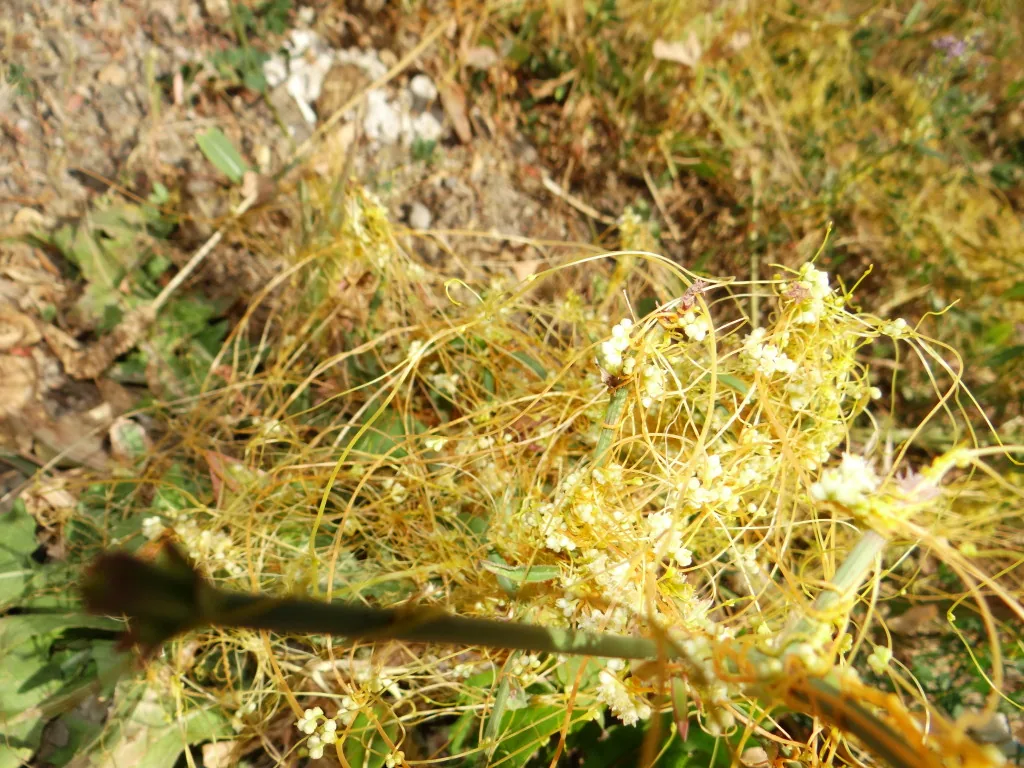
Dodder is an annual plant belonging to the dodder family (Cuscutaceae).
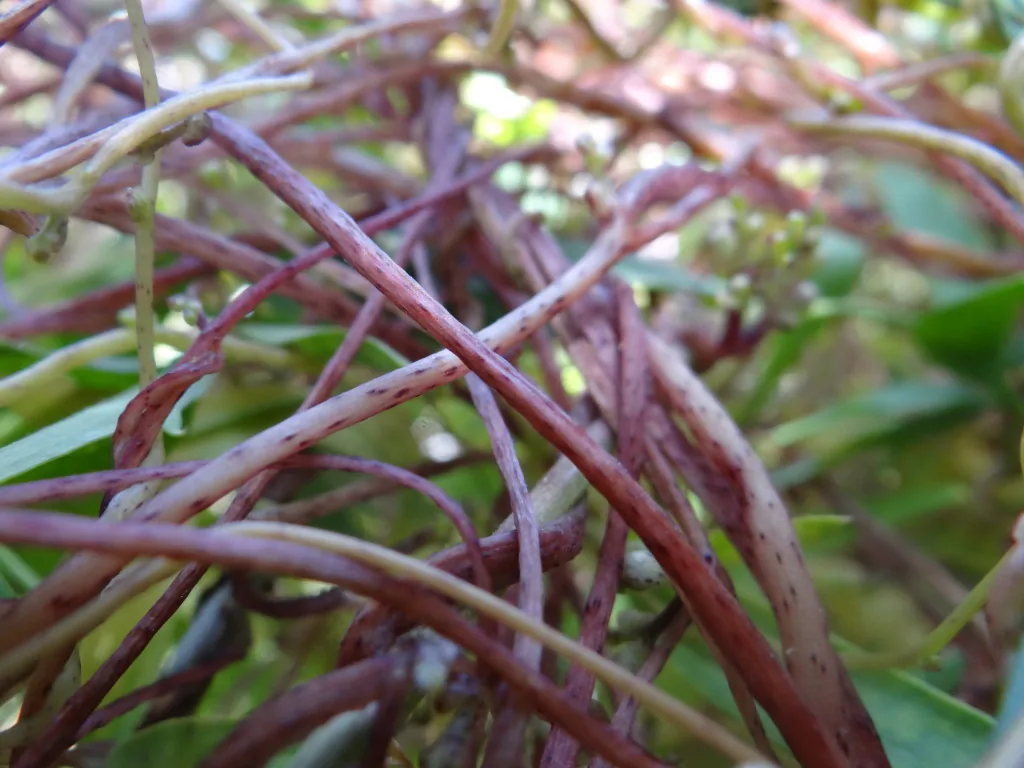
It resembles thin threads and has a yellowish-red colour. It twines around neighbouring plants, draws their sap, and grows at their expense.
Its stem is thin and yellowish-red.
The leaves are very small and scale-like.
The seeds are small and yellowish-red.
Dodder flowers in June–July.
Twenty-five species of dodder have been recorded in Tajikistan.
In gardens, vegetable plots, and cultivated fields, dodder wraps itself around neighbouring plants, draws nutrients from them, slows their growth and development, and reduces their yield.
Avicenna considered the nature of dodder to be hot and dry in the third degree. If it grows in a hot place, its heat is considered to be in the first degree.
Abumansur Muwaffaq considered the nature of dodder to be cold and moist.
Parts used
In medicine, the stems, or branches, and seeds of dodder are used.
The stems are cleaned of other plant material and cut into pieces 5–10 cm long.
The material is dried in a shaded, well-ventilated place.
The dried material is stored in paper or cardboard boxes or in bags for up to 1 year.
Medicinal properties
Dodder is attributed the following properties:
- calming effect on the central nervous system;
- diuretic;
- haemostatic;
- pain-relieving.
Use in medicine
In modern medicine, dodder is used in connection with some women’s health conditions.
These include:
- uterine prolapse;
- uterine bleeding.
It is also used in connection with:
- oncological tumours;
- neurasthenia;
- hysteria;
- impotence.
Use in ancient medicine
Avicenna used dodder for stomach disorders, jaundice, and pain or twisting around the navel.
Dodder was also used as a diuretic and as a means of stimulating menstruation.
It was attributed the ability to stop bleeding and relieve spasms of the joints.
Dodder was also used for melancholia and epilepsy.
When taken with honey, it was used to remove “savdo”, strengthen the stomach, and expel thick phlegm.
Abumansur Muwaffaq wrote:
“…dodder softens the abdomen, reduces heat in the liver, is beneficial for jaundice, and is useful for the chest and throat.”
Use in folk medicine
In folk medicine, dodder is used for:
- paralysis;
- numbness;
- insomnia;
- melancholia;
- joint pain;
- cancer;
- epilepsy;
- fearfulness;
- “savdo”;
- disturbing dreams;
- palpitations;
- intestinal parasites.
An amount of 20–30 g of dodder was mixed with freshly boiled milk and sugar, whey, or sikanjabin and taken internally.
(Zohidov H. 1991).
Medicinal forms, method of use, and dosage
Dodder infusion
20 g, or one tablespoon of the material, are placed in an enamelled or ceramic container and mixed with 200 ml, or one glass, of boiling water.
The mixture is infused for 1 hour.
It is then strained through 2–3 layers of gauze.
The infusion is used as a diuretic and pain-relieving preparation in an amount of 1/3 of a glass three times a day.
For uterine prolapse and uterine bleeding, the infusion is taken in an amount of one tablespoon 3 times a day.
In such cases, washing with the same infusion is also mentioned.
For oncological diseases, an amount of 2 tablespoons 3–4 times a day before meals is given.
Dodder decoction
20 g of dodder seeds are placed in an enamelled or ceramic container and mixed with 200 ml, or one glass, of boiling water.
The mixture is boiled in a water bath for 15 minutes.
It is then cooled at room temperature for 45 minutes.
Afterwards, it is strained through 2–3 layers of gauze.
It is taken in an amount of one tablespoon 3 times a day before meals.
This decoction is mentioned for impotence, hysteria, and neurasthenia.
A single amount of dodder is given as up to 17.5 g, while up to 35 g is given for an infusion.
(Zohidov H. 1991).
Warning
Information about medicinal properties, methods of use, and dosages on this page comes from the source text and partly belongs to folk and traditional medicine.
The text mentions the use of dodder for uterine bleeding, oncological diseases, nervous system disorders, and other serious conditions. This information should not be used as a guide to self-treatment.
The material is provided for educational and informational purposes.