
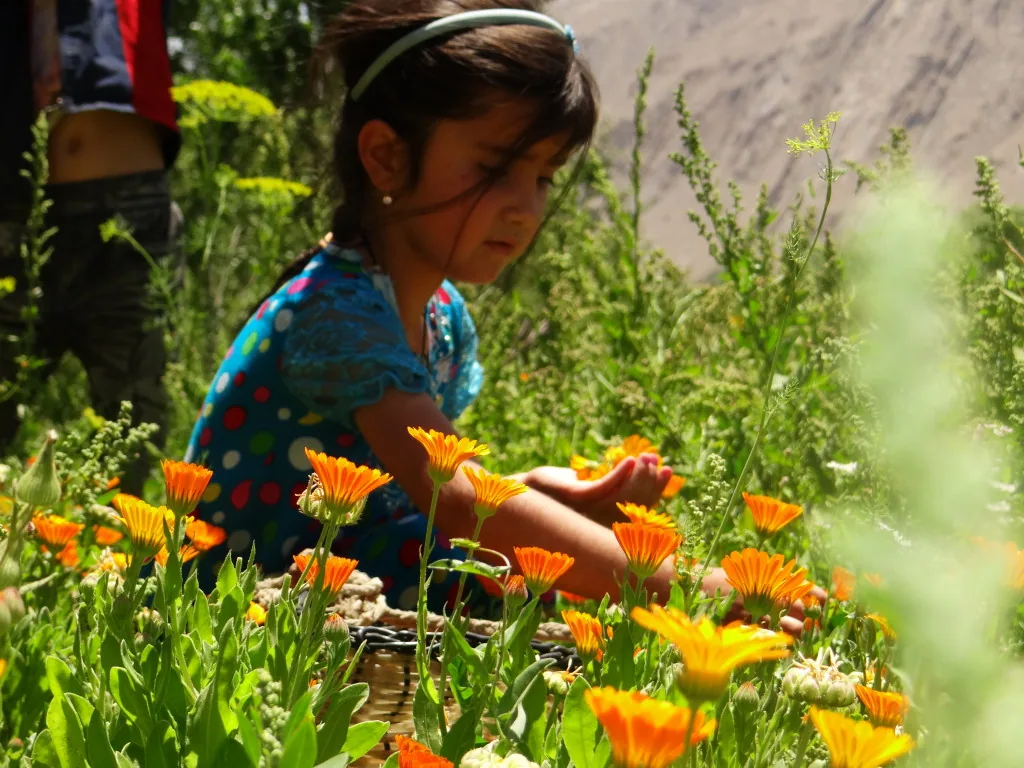
Names
Tajik: Гули хуҷаста (гули нохунак, хуҷаста, ханво, ҳамешабаҳор, гули зардак, озаргул)
Latin: Calendula officinalis L.
Russian: Календула лекарственная (ноготки)
Arabic: Озариён
Shughni-Rushani: Зирвухъак
English: Pot marigold
Description
Pot marigold is an annual herbaceous plant belonging to the Compositae family.
Its stem is upright and reaches approximately 30–70 cm in height.
The leaves are arranged alternately. The yellow-orange flowers are borne in separate, relatively large flower heads.
Pot marigold flowers in July–August, while its seeds ripen in August–October.
The original material presents different traditional descriptions of the plant’s nature. Abumansur Muwaffaq regarded it as moist and cold in the first degree, while G. P. Malakhov (1999) described it as hot and dry in the second degree.
Pot marigold is cultivated in all districts of Badakhshan as both a medicinal and ornamental plant.
Parts used
For medicinal purposes, the flowers, flower heads, and roots of pot marigold are used.
Chemical composition
According to the original material, the flowers contain carotenoids including carotene, lycopene, violoxanthin, citraxanthin, and rubixanthin.
The source also mentions:
- essential oils — approximately 0.02%;
- tannins — approximately 6.45%;
- organic acids;
- mucilaginous substances — approximately 4%;
- phytoncides;
- vitamin C.
The listed macronutrients include K, Ca, Mg, and Fe.
The listed trace elements include Co, Mo, Cr, Se, Ni, Sr, Pb, Ir, Ba, Mn, Cu, Zn, and Al.
Medicinal properties
The original material attributes anti-inflammatory, antiseptic, antispasmodic, calming, wound-healing, disinfecting, blood-pressure-lowering, choleretic, and other properties to pot marigold.
The source also mentions effects on heart function.
Bacteriostatic and bactericidal activity against staphylococci and streptococci is also described.
Use in medicine
The original material mentions the medicinal use of pot marigold flowers and roots.
Preparations made from the plant were used both on their own and in combination with other medicinal herbs, including chamomile, mint, and motherwort.
The source associates such preparations with certain diseases of the heart and blood vessels, vascular spasms, angina pectoris, nervous disorders, arterial hypertension, shortness of breath, oedema, and palpitations.
It also mentions use in connection with some disorders of the digestive system, including inflammation of the stomach, intestinal colic, gastric and duodenal ulcers, and inflammatory conditions of the liver and gallbladder.
The original material also describes use in connection with certain gynaecological conditions and during the climacteric period.
External use
The original material mentions alcoholic tincture and water infusion of pot marigold for external use.
They were used for rinsing and gargling in connection with certain inflammatory conditions of the throat, gums, and oral mucosa, as well as some diseases of the tissues surrounding the teeth and tonsillitis.
The source also mentions alcoholic tincture, ointment, juice, and emulsion in connection with wounds, ulcers, injuries, burns, boils, abscesses, and other conditions affecting the skin and soft tissues.
Use in traditional medicine
In traditional medicine, an infusion of pot marigold was used in connection with some diseases of the liver and gallbladder, jaundice, stones of the kidneys and urinary bladder, disorders of the spleen, constipation, arterial hypertension, and certain skin conditions.
The original material also includes several traditional uses of the juice, root, and other parts of the plant.
Some of these statements concern pregnancy, fertility, and termination of pregnancy. They are included here only as information recorded in the traditional source and should not be interpreted as medical advice.
The source also states that pot marigold herb was kept in homes as a means of repelling flies.
Medicinal forms
The original material mentions the following preparations made from the flowers, roots, leaves, and stems:
- water infusion;
- alcoholic tincture;
- juice;
- ointment;
- emulsion.
The source describes these preparations as being used internally, externally, in dressings, as drops, and for washing.
The original material also states that tablets known as KN were produced in the medical industry from powdered pot marigold flowers and nicotinic acid and were used in connection with the treatment of malignant tumours.
Alcoholic tincture of pot marigold
According to the original material, the tincture is prepared from flowers and flower heads using 70% alcohol in a ratio of 1:10.
The tincture is described as a clear yellow liquid.
The source mentions taking approximately one teaspoon of tincture diluted in one glass of water before meals as a choleretic preparation.
Pot marigold infusion
According to the original material, 20 g, or approximately one tablespoon, of plant material are placed in an enamelled container and covered with 200 ml of boiling water.
The mixture is heated in a water bath for approximately 15 minutes.
It is then cooled for about 45 minutes and strained.
The volume of the infusion is restored to 200 ml.
The source mentions taking approximately half a glass 30 minutes before meals.
Warning
The original material contains statements concerning the possible effects of pot marigold on pregnancy and reproductive processes.
These statements should not be interpreted as instructions for use or as confirmed modern medical recommendations.
The information on this page is presented for educational, historical, and informational purposes.
During pregnancy, in the presence of chronic illness, or when considering medicinal use of pot marigold, consultation with a qualified medical professional is necessary.