
Names
Tajik: Зилоли сурх (зирки сурх, зиришк)
Latin: Berberis vulgaris L.
Russian: Барбарис обыкновенный
Arabic: Анбарборис, анбарбирис
Ishkashimi: Зарғул
Wakhi: Зарғул
Shughni-Rushani: Зарғӯл
Yazgulami: Зъарб
English: Common barberry
Description
Common barberry is a perennial, highly branched thorny shrub belonging to the Berberidaceae family.
Its stem is upright, and the branches are covered with thorns. The plant can reach up to 3 metres in height.
The bark of young shoots is yellowish-brown, while older branches are brown.
The leaves are arranged alternately, thin, egg-shaped, and have a sour taste.
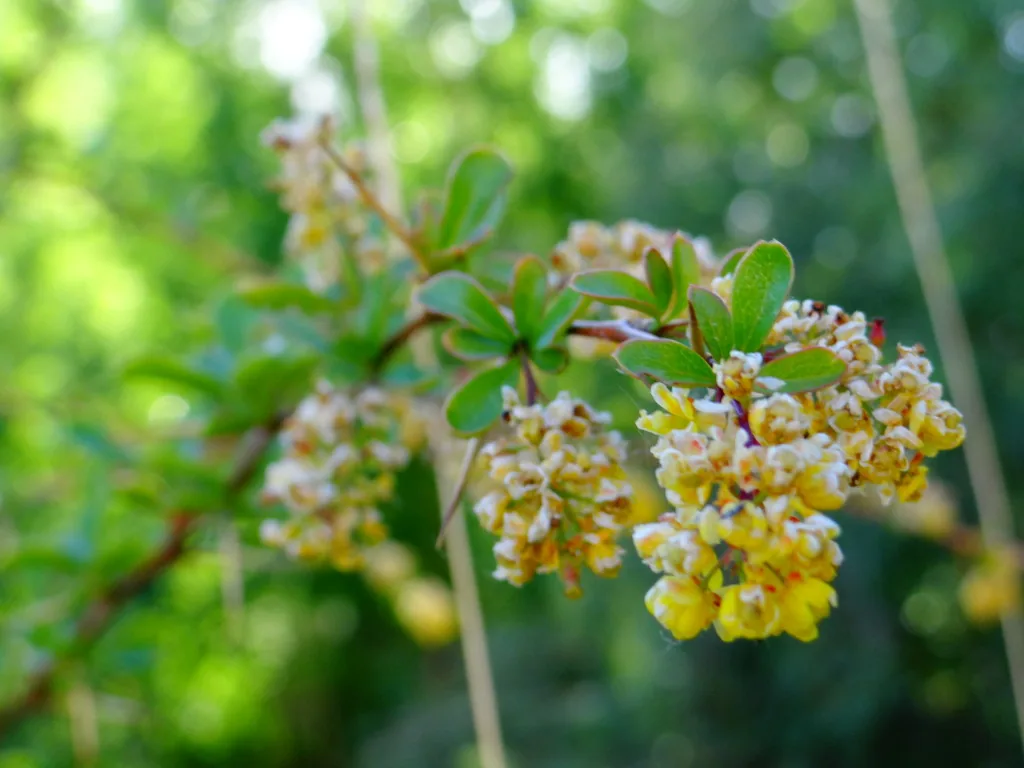
The inflorescence is simple, contains 10–20 flowers, and is 2–6 cm long.
The flowers are yellow and grow on short stalks.
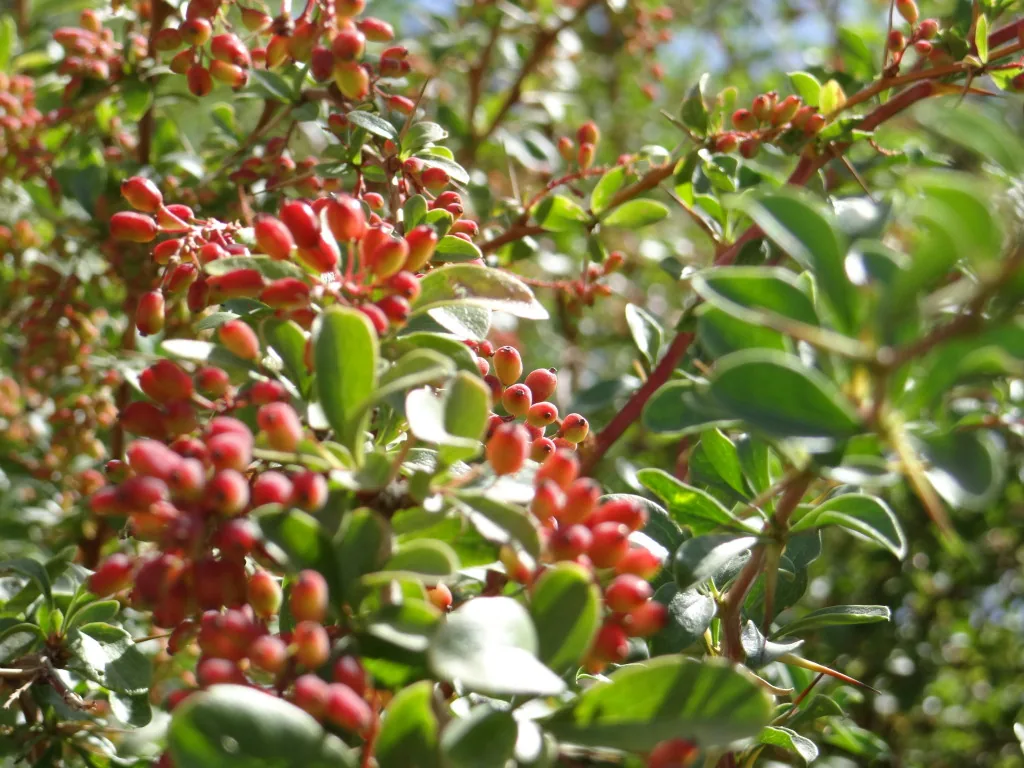
The fruits are juicy, elongated, purple in colour, and 2–9 cm long.
The seeds are brown, egg-shaped, and reach up to 4–6 cm in length.
Barberry flowers in May–June, and its fruits ripen in August–September.
Under the natural conditions of Badakhshan, barberry grows in all districts of the region except Murghab, along riverbanks, in valleys, and on sandy areas at elevations of 1,800–3,000 metres above sea level.
Avicenna considered the nature of barberry to be cold and dry in the third degree, while Abumansur Muwaffaq considered it cold and dry in the second degree.
Parts used
For medicinal purposes, the roots, bark, leaves, and fruits of barberry are used.
The roots are collected in spring before the buds open or in autumn after the fruits have ripened.
They are dug out, cleaned of soil and foreign material, washed in cold running water, cut into pieces 8–12 cm long, split lengthwise, and dried in a shaded, well-ventilated place or in special dryers at a temperature of +40–60°C.
The bark is collected during the sap-flow season in April–May.
The leaves are collected during flowering and dried in a shaded, well-ventilated place.
The collected medicinal material is stored in glass containers, cardboard boxes, or special bags for up to 3 years.
Chemical composition
The leaves and roots contain tannins, essential oils, and the following alkaloids:
- berberine;
- berbamine;
- oxyacanthine;
- palmatine;
- berlalibine;
- berbabumine;
- bervulsine;
- magnoflorine;
- columbamine;
- jatrorrhizine.
They also contain flavonoids, coumarins, and vitamins C and E.
The bark contains tannins.
The leaves and roots contain the following macroelements:
- K;
- Ca;
- Mg;
- Fe.
The listed trace elements include:
- Mn;
- Cu;
- Zn;
- Co;
- Mo;
- Cr;
- Al;
- Ba;
- Se;
- Ni;
- Sr;
- Pb.
(Kukes V. G. 1999; Khojimatov M. 1989; Safonov N. N. 2005).
Medicinal properties
Barberry is attributed the following properties:
- anti-inflammatory;
- choleretic;
- calming;
- diuretic;
- diaphoretic;
- haemostatic;
- antiseptic;
- antimicrobial;
- pain-relieving;
- hypotensive.
Use in medicine
Avicenna wrote:
“…barberry strengthens the stomach and liver and relieves thirst. Its poultice is beneficial for hot swellings, has an astringent effect, helps with uterine discharges, and stops bleeding from below.”
Abumansur Muwaffaq wrote in his book “Giyohnoma”:
“…anbarbaris is beneficial for pain of the liver, stomach, and intestinal sores; it strengthens the liver and stomach, relieves thirst, and has an astringent effect.”
Muhammad Husayn Shirazi wrote in “Makhzan-ul-Adwiya”:
“…barberry relieves thirst, strengthens the liver, stomach, and heart, and is beneficial for haemorrhoids.”
In combination with takhach, barberry was attributed a digestive effect, while with saffron it was considered diuretic.
Together with cinnamon and honey, it was used for dropsy, diarrhoea, and chronic fevers.
Barberry preparations were considered beneficial for people with a hot temperament and harmful for those with a cold and moist temperament.
Barberry was considered unsuitable for people suffering from colic, constipation, and flatulence.
People with a cold and moist temperament were advised to take barberry with pepper.
Use in the medicine of different countries
In many countries, barberry and preparations made from it have been used for various diseases.
In Bulgarian medicine, a decoction of the roots and bark was used for liver diseases, gallstones, jaundice, inflammation of the kidneys and bladder, gout, and rheumatism.
A decoction of the leaves was used for bleeding and bloody diarrhoea.
In France, Poland, Germany, Austria, and England, decoctions and infusions of the roots, bark, leaves, and fruits were used for:
- inflammatory diseases of the liver and gallbladder;
- diseases of the bile ducts;
- diseases of the stomach and intestines;
- internal bleeding;
- inflammatory diseases of the respiratory tract;
- bloody diarrhoea.
Barberry was also used as a fever-reducing, thirst-relieving, and vitamin-rich remedy.
Use in folk medicine
In Russian folk medicine, the fruits and bark of barberry were used as haemostatic, antidiarrhoeal, choleretic, diaphoretic, and astringent remedies.
(Kovaleva N. G. 1971).
In Tajik folk medicine, an infusion, or tea, made from barberry leaves was used for jaundice.
A decoction of the roots and bark was used for jaundice and as a haemostatic, choleretic, and diuretic remedy.
(Khojimatov M. 1989).
In the folk medicine of Badakhshan, decoctions and infusions of the bark, roots, leaves, and fruits were used for diseases of the liver, jaundice, kidney and bladder disorders, fractures, and dislocated joints.
The powdered material was also used for inflammation of the gums.
Household use
Barberry fruits are used to prepare:
- jam;
- compote;
- drinks;
- wine.
Medicinal forms, methods of use, and dosage
Barberry leaf infusion
10 g, or two teaspoons of leaves, are placed in an enamelled container and covered with 200 ml, or one glass, of boiling water.
The mixture is heated over low heat or in a water bath for 15 minutes and then cooled at room temperature for 45 minutes.
It is strained through 2–3 layers of gauze, the remaining plant material is pressed, and the volume of the infusion is restored to the original amount.
It is taken in an amount of one tablespoon 3–4 times a day before meals.
The infusion was used for inflammatory diseases of the liver and gallbladder as an anti-inflammatory and choleretic remedy.
Barberry bark infusion
20 g, or one tablespoon of barberry bark, are placed in an enamelled container and covered with 400 ml, or two glasses, of boiling water.
It is infused for 4 hours.
After straining, it is taken in an amount of 1/4 of a glass 3–4 times a day before meals.
The infusion was used for diseases of the kidneys and bladder.
Barberry root infusion
5 g, or one teaspoon of barberry root, are infused in two glasses of cold water for 4 hours and then strained.
It is taken in an amount of half a glass 4 times a day before meals.
The infusion was used for uterine bleeding after childbirth.
Alcoholic tincture of barberry leaves
Barberry leaves are infused in 40% alcohol at a ratio of 1:5 for two weeks and then strained.
The tincture is taken in an amount of 30–40 drops 2–3 times a day before meals.
It was used for diseases of the liver and gallbladder.
The duration of treatment was 2–3 weeks.
Pharmaceutical preparations
In the pharmaceutical industry, the preparation “Berberine bisulfate” is produced from barberry in tablet form.
It was used for chronic inflammatory diseases of the liver, liver and gallbladder conditions, inflammation of the gallbladder, and gallstone disease.
The text gives a dosage of 0.005–0.1, or 5–10 mg, three times a day, 30 minutes before meals.
The duration of treatment is given as 2–3 weeks.
Contraindications
The use of barberry and preparations made from it is contraindicated for pregnant women, people with low blood pressure, and those suffering from colic, constipation, or flatulence.
Warning
Information about medicinal properties, methods of use, dosages, and contraindications on this page comes from the original text and partly belongs to traditional and folk medicine.
The information is provided for educational and informational purposes and should not be used as a guide to self-treatment.