Names
Tajik: Пудинаи обӣ (ҳулба, ҳулбу, фудина)
Latin: Mentha asiatica Boris.
Russian: Мята азиатская
Arabic: Футанаҷ
Ishkashimi: Пудина
Wakhi: Ванд
Shughni-Rushani: Боғивидъм, узнихъаци
Yazgulami: Вазъм
English: Asian mint
Description
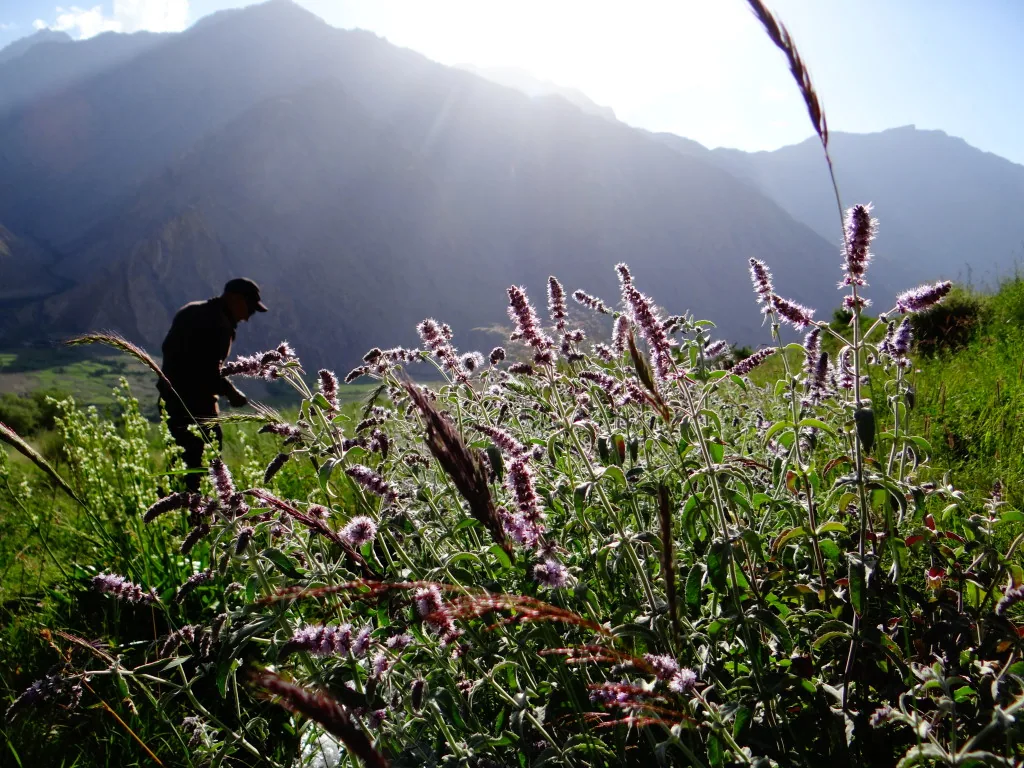
Asian mint is a perennial herbaceous plant belonging to the Labiatae family.
Its stem is four-angled. The lower part is usually less branched and almost leafless, while the upper part is more strongly branched.
The plant may reach approximately 150 cm in height.
The leaves are elongated, oval, and have toothed margins.
The inflorescences are approximately 3–6 cm long. Small pink flowers appear from June to August.
The seeds ripen in August–September.
The original material states that several species of mint grow in Tajikistan, including field mint (Mentha arvensis), Asian mint (Mentha asiatica), peppermint, and other mint species.
According to I. Khaitov (2004), Asian mint (Mentha asiatica Boris.), spearmint (Mentha spicata), and field mint (Mentha arvensis L.) occur in Badakhshan.
The source also states that these mint species contain approximately 0.1–0.5% essential oil, with menthol forming a substantial part of it.
Asian mint grows at elevations of approximately 1,800–3,500 metres above sea level, along streams, near springs, in foothill areas, and in wetlands.
Parts used
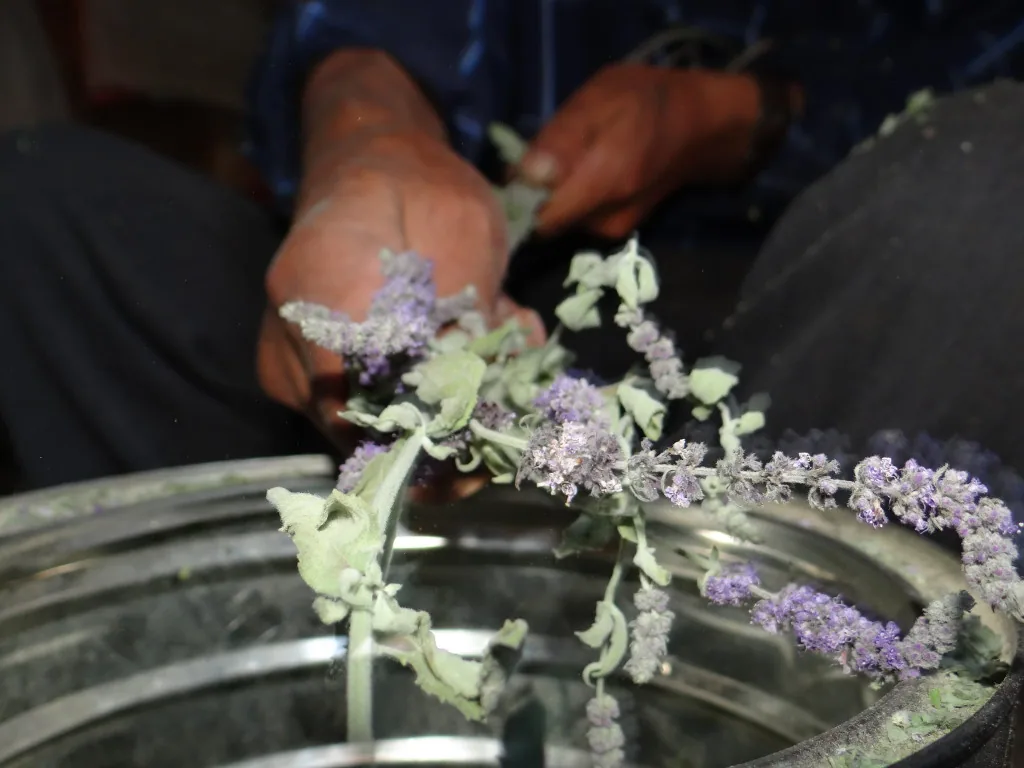
In traditional medicine, the above-ground parts of the plant are used for medicinal purposes.
They are collected during the budding and flowering periods.
The original material specifically notes that Asian mint is not used in modern medicine.
Chemical composition
The original material describes Asian mint as an essential-oil-bearing, honey-producing, and food plant.
The leaves and stems are reported to contain:
- essential oil — approximately 0.05%;
- vitamin C — approximately 66.7–97.7 mg%;
- carotene — up to 11.9 mg;
- catechins and leucoanthocyanins — up to 100 mg%;
- menthol;
- ketones;
- organic acids;
- flavonoids;
- trace elements;
- tannins;
- resinous substances.
The original material cites works by Yu. E. Alekseev (1971), D. Navruzshoev and others (1998).
Medicinal properties
The original material attributes vasodilating, antispasmodic, calming, choleretic, anti-inflammatory, carminative, pain-relieving, antiseptic, and antidotal properties to Asian mint.
Use in medicine
The original material includes information from Abumansur Muwaffaq’s “Giyohnoma”, where a number of traditional uses of Asian mint are described.
These include the use of crushed plant material and its juice with honey, external application for certain types of pain, and statements concerning menstruation and pregnancy.
These statements are presented here as historical and traditional information and should not be interpreted as medical advice.
In traditional medicine, the leaves and stems of Asian mint were used in connection with some diseases of the heart and blood vessels, vascular spasms, gallstone disease, and inflammation of the gallbladder and stomach.
The source also mentions its use in connection with certain diseases of the respiratory tract, including inflammation of the bronchi, trachea, and throat.
Asian mint was also used in connection with insomnia, neuralgia, nausea, heartburn, and to support digestion.
The original material also mentions its use in connection with pulmonary tuberculosis and certain skin conditions.
Use as food
Asian mint, especially its leaves, is also used as a food plant.
The original material states that mint leaves are added to various dishes.
They are also used in the preparation of sambusa, tushbera, and mantu.
Medicinal forms, preparation, and dosage
The original material provides methods for preparing an infusion and a decoction from Asian mint leaves.
Infusion of Asian mint leaves
10 g, or approximately two teaspoons of the herb and leaves, are placed in an enamelled container.
Then 200 ml of boiling water are added.
The mixture is heated for approximately 10 minutes in a water bath or over low heat.
It is then cooled at room temperature for about 40 minutes and strained through gauze.
The original material states that approximately half a glass is taken three times a day, 15–20 minutes before meals.
In the source, this infusion is mentioned in connection with gallstone disease and as a calming and antispasmodic preparation.
Decoction of Asian mint leaves
10 g, or approximately two teaspoons of plant material, are placed in an enamelled container and covered with 200 ml of boiling water.
The mixture is boiled over low heat or in a water bath for approximately 10 minutes.
After cooling, the decoction is strained through 2–3 layers of gauze.
The remaining plant material is pressed.
The original material states that approximately half a glass is taken three times a day, 30 minutes before meals.
Warning
The original material contains traditional and historical statements concerning menstruation, pregnancy, and other medical conditions.
These statements should not be interpreted as instructions for self-treatment or direct medicinal use.
The information on this page is presented for educational, historical, and informational purposes.
During pregnancy, in the presence of chronic illness, or when considering Asian mint for medicinal purposes, consultation with a qualified medical professional is necessary.