
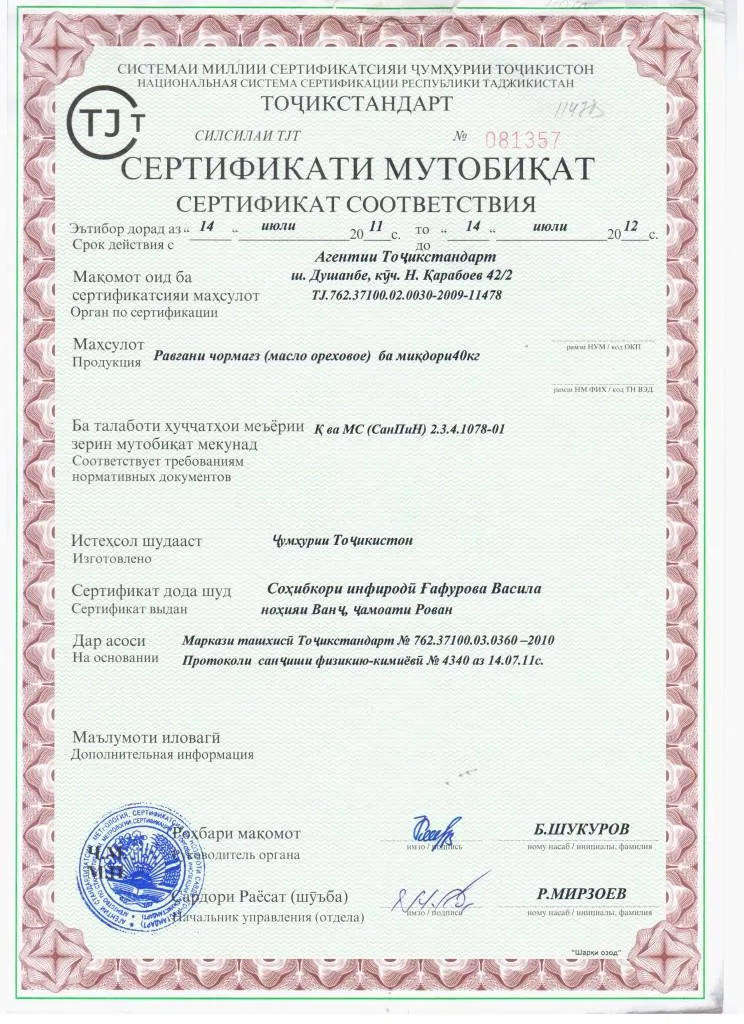
Sea buckthorn oil is described in the source material as one of the purest natural products found in abundance in Badakhshan. The Vanj district is especially rich in this healing product. It is here that Vasila Gafurova’s sea buckthorn oil is produced, known throughout the Republic of Tajikistan. In the village of Guchovas, where Vasila comes from, there is a workplace for producing natural oils. It is equipped with modern equipment and meets applicable norms and standards.
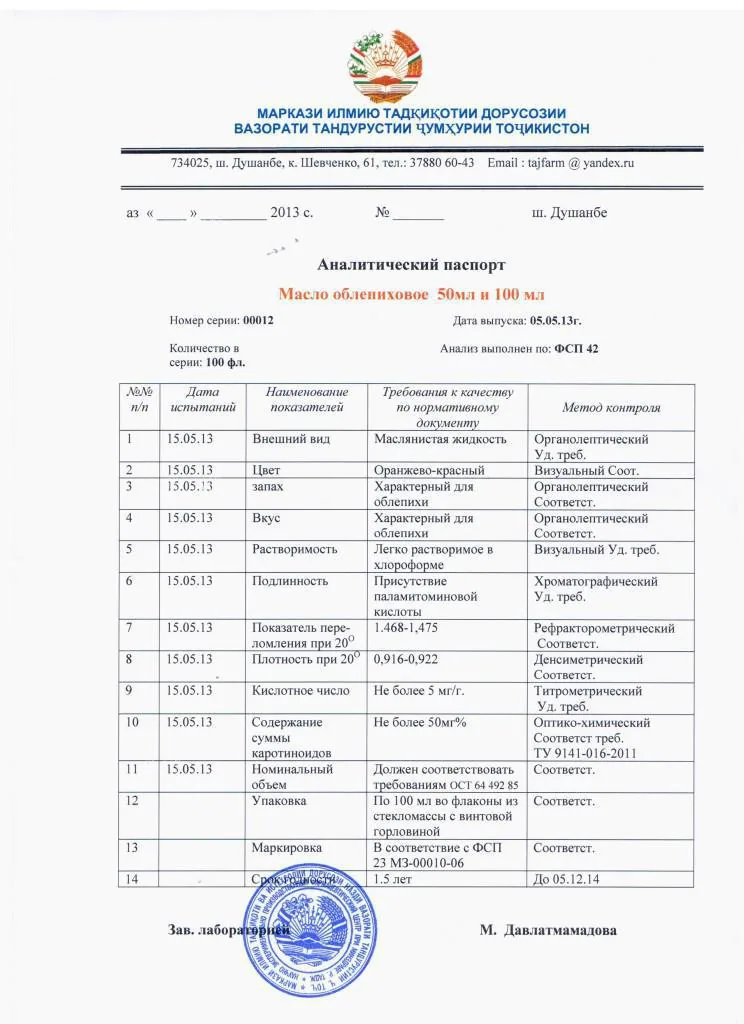
Sea buckthorn oil is produced from the fruits of sea buckthorn, one of the few multivitamin crops. This oil is a unique and balanced food product. It contains a mixture of carotene and carotenoids (not less than 180 mg%), tocopherols, glycerides of oleic, linoleic, palmitic, and stearic acids; chyloconin, pectin, phospholipins, and trace elements.
It is described as being indicated for wounds, including burns, cracks, ulcers, pressure sores, radiation injuries of the skin, anemia, hypovitaminosis, diseases of the stomach, and diseases of the upper respiratory tract. It is described as a rich source of natural vitamins.
The oil is described as having a reparative effect in cases of damage to the skin and mucous membranes. It activates the exocrine activity of the pancreas, inhibits the secretion of gastric juice, and protects cell membranes from the damaging effects of chemical agents.
It contains vitamins E, C, B1, B2, B6, F, and P; folic acid; organic acids; flavonoids (rutin); tannins; and macro- and microelements (Mg, Si, Fe, Ca, Ni, Mo, Mn, Sr).
Traditional applications described in the source
For people with cardiovascular disease, arterial hypertension, and ischemic heart disease, the source describes taking 1 teaspoon of sea buckthorn oil 3 times a day, half an hour before meals. The course is described as lasting 30–40 days.
For the same group, it describes taking an alcoholic infusion of sea buckthorn leaves (3 tablespoons of leaves in 150 ml of 96% alcohol), ½ teaspoon 3 times a day, 30 minutes before meals. It also describes taking an infusion of sea buckthorn leaves (1 tablespoon of leaves in 1 litre of water), ½ glass 3 times a day before meals.
For people with anemia, the source describes drinking tea made from sea buckthorn shoots and leaves (2 tablespoons of leaves and shoots in 500 ml of water), ½ glass at a time.
For inflammation and ulcers of the stomach and duodenum with reduced acidity, it describes taking a decoction of sea buckthorn leaves (3 tablespoons of leaves in 500 ml of water) and sea buckthorn oil (1 teaspoon), 3 times a day, 30–40 minutes before meals. The course is described as lasting 3–4 weeks.
For diarrhea, the source describes drinking a decoction of sea buckthorn seeds (1 tablespoon of seeds in 200 ml of water) with 1 teaspoon of honey, 3 times a day before meals. It also describes taking an infusion of sea buckthorn bark (100 g of bark in 500 ml of water) and sea buckthorn fruit juice, ½ glass 3 times a day before meals (Mitrofanova T., 2005).
For ulcers of the rectum, hemorrhoids, inflammation of the uterine mucosa, inflammation of the cervix (endocervicitis), and cervical erosion, the source describes placing, daily before sleep for 2–3 weeks, a tampon soaked in sea buckthorn oil or a suppository containing sea buckthorn oil in the rectum and vagina.
For diabetes, it describes taking an infusion and tea made from sea buckthorn leaves, including mixtures with other medicinal plants.